Databricks Genie for Finance: A Life Sciences CFO's Guide
How pharma, medtech and CRO finance teams use Databricks Genie to get governed, plain-language answers on R&D spend, the close, procurement and margin.


In life sciences, the Office of the CFO sits on some of the most valuable data in the enterprise: R&D portfolio spend, clinical trial accruals, gross-to-net, product-line margins, supplier contracts and cash runway. Yet finance leaders are still among the most underserved users of data and AI. A simple question from the board, such as "What's driving the overrun in our Phase III programs?", can take days of exports, VLOOKUPs and reconciliations to answer.
Databricks Genie changes that. It lets finance leaders ask questions of their governed data in plain language and get a trustworthy answer in seconds, using the same metric definitions and access controls the business already relies on.
This guide is written for finance leaders in pharma and biotech, medical devices, and CROs/CDMOs. It covers why life sciences finance has a distinct data problem, why a governed data foundation comes first, the five roles in the Office of the CFO and the Genie use case that answers each one's pain, and how to keep AI-generated answers audit-ready.
Why life sciences finance has a different data problem
Life sciences finance carries all the usual CFO tensions (control vs. speed, governance vs. innovation, capital preservation vs. growth) plus pressures unique to the industry. Those pressures are why generic dashboards and static reports rarely keep up.
- Long, lumpy investment cycles. R&D and clinical spend run across multi-year programs, with accruals tied to site activity, patient enrollment and CRO milestones. Explaining variance requires data from clinical, procurement and the ERP at once.
- Revenue that's hard to see clearly. In pharma and biotech, gross-to-net adjustments such as rebates, chargebacks and government pricing obligations make true net revenue by product and channel difficult to track in near real time.
- Margin pressure from the supply chain. Medtech and pharma manufacturers face input-cost volatility, tariff and trade-policy shifts, and supplier concentration risk, all of which hit product-line margin before they show up in the monthly close.
- Project-based economics. For CROs and CDMOs, profitability lives at the contract and study level: utilization, change orders, pass-through costs and revenue recognition across long-running programs.
- Heavy regulatory scrutiny. SOX, revenue recognition standards and, for many teams, data-integrity expectations from a GxP environment mean every number must be traceable. A fast answer that can't be defended is no answer at all.
The common thread: the data finance needs is spread across ERP, CTMS, procurement, HRIS and planning tools, and the questions are urgent, cross-functional and specific to how each company defines its metrics.
Start with the foundation: governed data first, Genie next
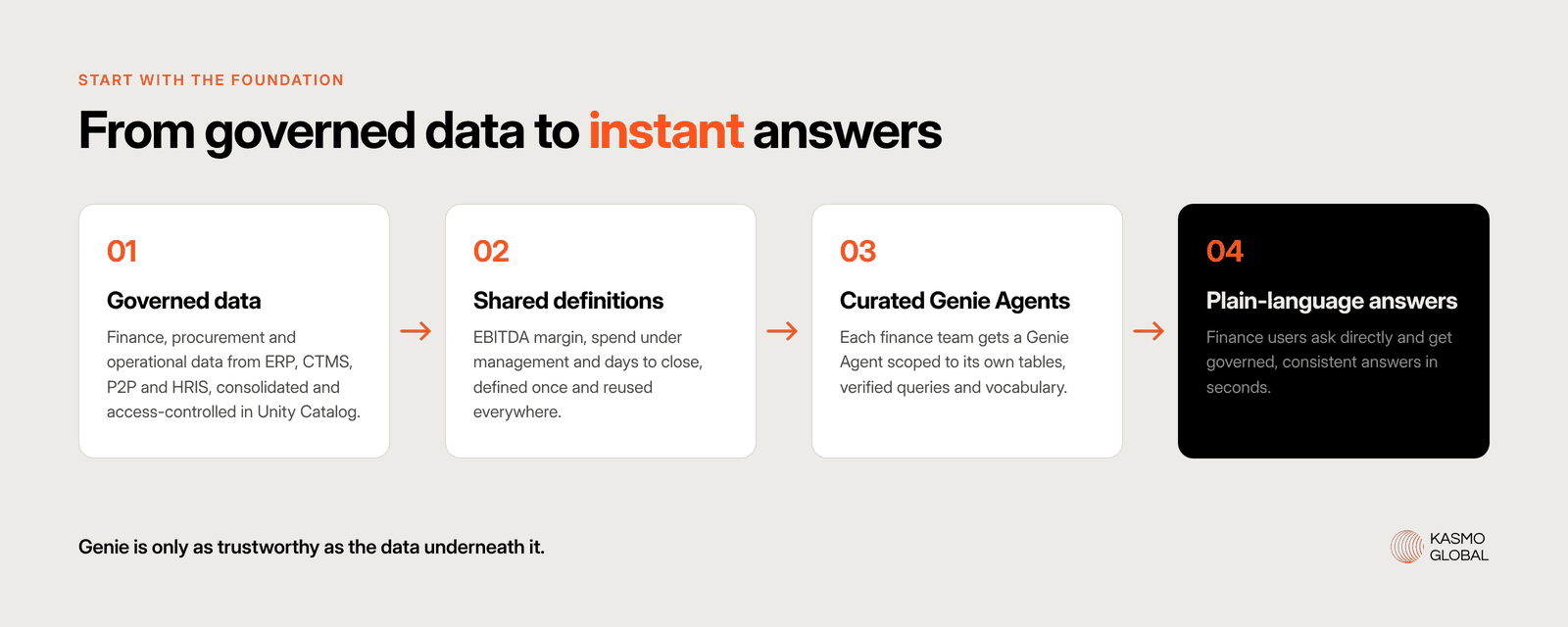
Genie is only as trustworthy as the data and definitions underneath it. Getting finance a reliable answer means encoding exact metrics: how your company defines net revenue, which cost centers roll into R&D, what counts as off-contract spend. That context usually lives in the heads of senior analysts.
Many life sciences finance teams have already done the hard part. They have consolidated ERP, procurement and clinical data onto Databricks, governed it with Unity Catalog, and used that single source of truth to shorten the close and cut manual effort. When that foundation exists, Genie is the natural next step rather than a standalone project:
- Governed data. Finance, procurement and operational data are consolidated and access-controlled in Unity Catalog.
- Shared definitions. Metrics such as EBITDA margin, spend under management and days to close are defined once and reused everywhere.
- Curated Genie Agents. Each finance team gets a Genie Agent (formerly a Genie space) scoped to its own tables, verified queries and business vocabulary.
- Plain-language answers. Finance users ask questions directly and get governed, consistent answers, with no waiting on analysts and no conflicting versions.
If the foundation is still in progress, that is where to begin, and a well-scoped Genie pilot can help prove the value of finishing it. Our data and AI services focus on exactly this foundation.
The Office of the CFO isn't one buyer: five roles, five pains
The Office of the CFO is a set of connected functions, each with its own priorities, time horizon and definition of value. It spans Investor Relations, Treasury and Tax too, but these five roles are where Genie changes the day-to-day most.
1. CFO: the strategic sponsor
What they own: capital allocation across the pipeline and portfolio, cash and working capital, and the story to the board and investors.
The pain: strategic questions get siloed answers, slowly. By the time a board question becomes a reconciled analysis, the decision window has often moved.
Where Genie lands: an executive copilot for faster, mobile-friendly insight. The CFO can ask about margin drivers, quarter-end opex projections or cash conversion directly, so the finance team spends its time on strategy, not data wrangling.
Example question: "What are the top three drivers of the change in our full-year EBITDA forecast versus last quarter, by franchise?"
2. VP of FP&A: the business partner and storyteller
What they own: budget vs. actuals, forecasting, reforecasts and the variance story back to R&D, commercial and operations leaders.
The pain: "flying blind" between reporting cycles, and a constant queue of ad hoc variance questions that require stitching together ERP, planning and headcount exports.
Where Genie lands: real-time budget vs. actuals and variance root-cause analysis, plus self-serve cost-center reporting for business partners. FP&A gets its capacity back for investment recommendations.
Example question: "Which clinical programs are furthest over budget this quarter, and is it driven by enrollment, site costs or CRO fees?"
3. Head of Procurement: the buyer
What they own: strategic sourcing, supplier contracts, category spend, and supplier performance and risk, from APIs and components to CROs and lab services.
The pain: off-contract (maverick) spend quietly leaking negotiated savings, and spend visibility fragmented across ERP, P2P platforms and contract repositories.
Where Genie lands: spend analysis by supplier, category and business unit; off-contract spend detection across all vendors; and supplier performance tracking.
Example question: "What is our spend under management by category, and which supplier contracts renew in the next 120 days?"
4. Controller: the guardian of accuracy
What they own: GL integrity, the month- and quarter-end close, revenue recognition, SOX controls and the external audit.
The pain: unposted entries, unreconciled items and manual matching across systems that delay the close and invite audit findings.
Where Genie lands: faster close monitoring, cross-system reconciliation, GL anomaly detection and compliance checks, all through natural-language questions instead of complex ERP screens.
Example question: "Show manual journal entries over $50k posted in the last seven days without an approved PO line."
5. Finance Transformation: the modernizer
What they own: the finance modernization roadmap, from system consolidation and data quality to automation and AI adoption.
The pain: expensive programs that stall or never get adopted, plus change fatigue in a team that has seen many initiatives come and go.
Where Genie lands: a fast, visible win. Because Genie sits on governed data with verified queries, it delivers self-service AI that is accurate and defensible from day one. Because users simply ask questions, adoption follows.
Example question: "Which finance workflows had the most manual adjustments and reconciliation errors this quarter?"
At a glance: persona, pain and the Genie use case that lands

- CFO. Pain: siloed answers to strategic questions, delivered too slowly. Genie use case: faster insights (including on mobile), cost control and a strategy-focused team.
- VP, FP&A. Pain: "flying blind" between cycles and endless variance requests. Genie use case: real-time budget vs. actuals and variance root-cause analysis.
- Head of Procurement. Pain: off-contract spend quietly leaks savings. Genie use case: spend analysis and off-contract spend detection across all vendors.
- Controller. Pain: unposted entries and audit findings delay the close. Genie use case: faster close, reconciliation and compliance checks.
- Finance Transformation. Pain: modernization programs that stall or don't get adopted. Genie use case: scalable AI adoption, faster time to value and measurable ROI.
Fast and defensible: keeping AI answers audit-ready
The Office of the CFO is accountable for the numbers leadership, regulators and auditors see. In life sciences, defensibility isn't a feature request; it's table stakes. A Genie deployment for finance should be designed with that in mind:
- Inherited access controls. Genie respects Unity Catalog permissions, so a cost-center owner sees only the data they are authorized to see.
- Verified queries and certified metrics. Curators define trusted SQL for critical metrics so that "net revenue" or "days to close" means the same thing in every answer.
- Transparent answers. Users can inspect the query behind a response, which makes results reviewable rather than a black box.
- Human judgment stays in the loop. Genie accelerates analysis; finance leaders still own the conclusions that go to the board or into a filing.
- Clear scope. Each Genie Agent covers a defined set of tables and questions for one team, which keeps answers precise and governance manageable.
This is how finance teams get both halves of the CFO's core tension: real-time insight and quarterly-reporting precision.
How Kasmo Global helps life sciences finance teams get started
Kasmo Global works with pharma, biotech, medtech and CRO/CDMO organizations to turn their Databricks investment into answers finance can trust. We start where your team feels the most pain, not with a feature list. Our Genie Readiness Assessment gives finance leadership a clear, practical starting point:
- Prioritize the persona and pain. We identify which Office of the CFO role, whether FP&A, Controller, Procurement or the CFO, has the highest-value questions to answer first.
- Assess the data foundation. We review how finance, procurement and operational data is consolidated and governed in Databricks and Unity Catalog.
- Define the metrics that matter. We document the definitions and verified queries Genie needs to answer accurately in your company's language.
- Scope a pilot Genie Agent. We design a focused, measurable pilot with clear success criteria such as time to answer, close days or spend under management.
- Plan for adoption and scale. We map how the pilot expands across finance without compromising governance.

Ready to give your finance team answers in seconds instead of days? Book a Genie Readiness Assessment with Kasmo Global and find out where Genie can deliver value first in your Office of the CFO. You can also explore how we support pharmaceutical and medical device companies.
Frequently asked questions
What is Databricks Genie for finance?
Databricks Genie is a conversational analytics capability that lets finance users ask questions of governed data in plain language. It returns answers based on the company's own tables, metric definitions and access controls.
How can life sciences finance teams use Databricks Genie?
Common uses include variance root-cause analysis for R&D and clinical programs, real-time budget vs. actuals, off-contract spend detection, close and reconciliation monitoring, and product-line margin and EBITDA tracking.
Is Databricks Genie secure enough for regulated finance data?
Genie inherits Unity Catalog permissions, so users see only the data they are authorized to access. Verified queries and visible SQL help keep answers consistent and reviewable for SOX and audit purposes.
Do we need a governed data foundation before using Genie?
Yes. Genie depends on consolidated, governed data and clear metric definitions. Teams that already run finance data on Databricks can typically move to a pilot quickly; others start by building that foundation.
Which finance role benefits most from Genie?
It depends on where the pain is greatest. FP&A and Procurement tend to ask the highest volume of questions, Controllers gain the most from close and reconciliation use cases, and the CFO benefits from faster, consistent answers at the executive level.
How do we get started?
Start with a focused readiness assessment: pick one persona and pain, confirm the data foundation, define the key metrics, and launch a measurable pilot Genie Agent. Kasmo Global's Genie Readiness Assessment follows exactly this approach.
Put this into practice with our team
Share what you are working on and we will show how governed data and AI can move your programs forward.
Email marketing@kasmoglobal.com