What Is Life Sciences Forward Deployed Engineering on Databricks?
How Kasmo Global's US-based forward deployed engineers take pharma, biotech and medtech use cases to production on Databricks, with fees tied to agreed KPIs.

By Usha Bangaru, President, Kasmo Global · Published November 17, 2026
Life sciences forward deployed engineering (FDE) is a delivery model in which engineers work inside a pharma, biotech or medtech team and build production data and AI systems with them, rather than advising from outside. Kasmo Global Life Sciences FDE is a US-based team of 15+ Databricks-certified engineers that takes life sciences use cases from first workshop to production on the Databricks Data + AI Platform, with part of Kasmo Global's fees tied to KPIs agreed with the customer.
In short
- Kasmo Global forward deployed engineers build in the customer's own Databricks workspace and code repository from day one.
- Four engagements: Use-Case Sprint to Production, Migration Assurance, AI Agent and Genie Deployment, and Life Sciences CoE and Run.
- Seven named delivery risks each get a named control and a go/no-go gate, so outcome risk is visible at every stage.
- Fees are tied to agreed KPIs, and all delivery is from the United States.
What does a Kasmo Global forward deployed engineer do?
A Kasmo Global forward deployed engineer is a hands-on Databricks engineer with life sciences domain knowledge who sits with commercial, clinical, R&D or quality teams and builds the pipelines, governed data products, AI agents and applications they need. Each Kasmo Global FDE pod combines an engagement lead who owns the KPI, data engineers working in Lakeflow, governance engineers working in Unity Catalog and Unity Gateway, AI engineers working in Agent Bricks and the Genie family, and application engineers working in Databricks Apps and Lakebase Postgres.
Which engagements does the Kasmo Global FDE team offer?
The Kasmo Global Life Sciences FDE team offers four engagements, each run through the same five stages (Discover, Build, Prove, Scale, Run) and each ending with a working system in the customer's Databricks workspace.

| Engagement | What it delivers | Exit criteria |
|---|---|---|
| Use-Case Sprint to Production | One prioritized use case taken from discovery to a production release, with the KPI baseline and target agreed before build | Live for named users; KPI measured from production data |
| Migration Assurance | Assessment, code conversion and validated cut-over from legacy warehouses, Hadoop, SAS or SQL Server, with reconciliation evidence | Workloads reconciled on Databricks; legacy jobs retired on schedule |
| AI Agent and Genie Deployment | Governed AI agents and Genie experiences for commercial, medical, clinical or R&D users, with evaluation sets and human review | Agreed evaluation threshold passed; human review in place |
| Life Sciences CoE and Run | Standards, templates and a managed run team that keeps use cases healthy, optimized and audited | Standards adopted; service levels and cost per use case reported monthly |
What use cases does Kasmo Global build for pharma, biotech and medtech?
The Kasmo Global FDE team starts each use case from a life sciences KPI. Pharma teams most often ask for HCP and HCO 360 with next best action, and for trial feasibility and site selection. Biotech teams ask for target identification and clinical data modernization. Medtech teams ask for smart manufacturing, supply chain visibility and complaint trending. Three Kasmo Global accelerators give these builds a working starting point: Commercial Copilot for commercial and field teams, Clinical Trial Intelligence Agent for site selection with human review, and Kasmo Global Research Intelligence for early discovery research.

How does Kasmo Global de-risk data and AI outcomes?
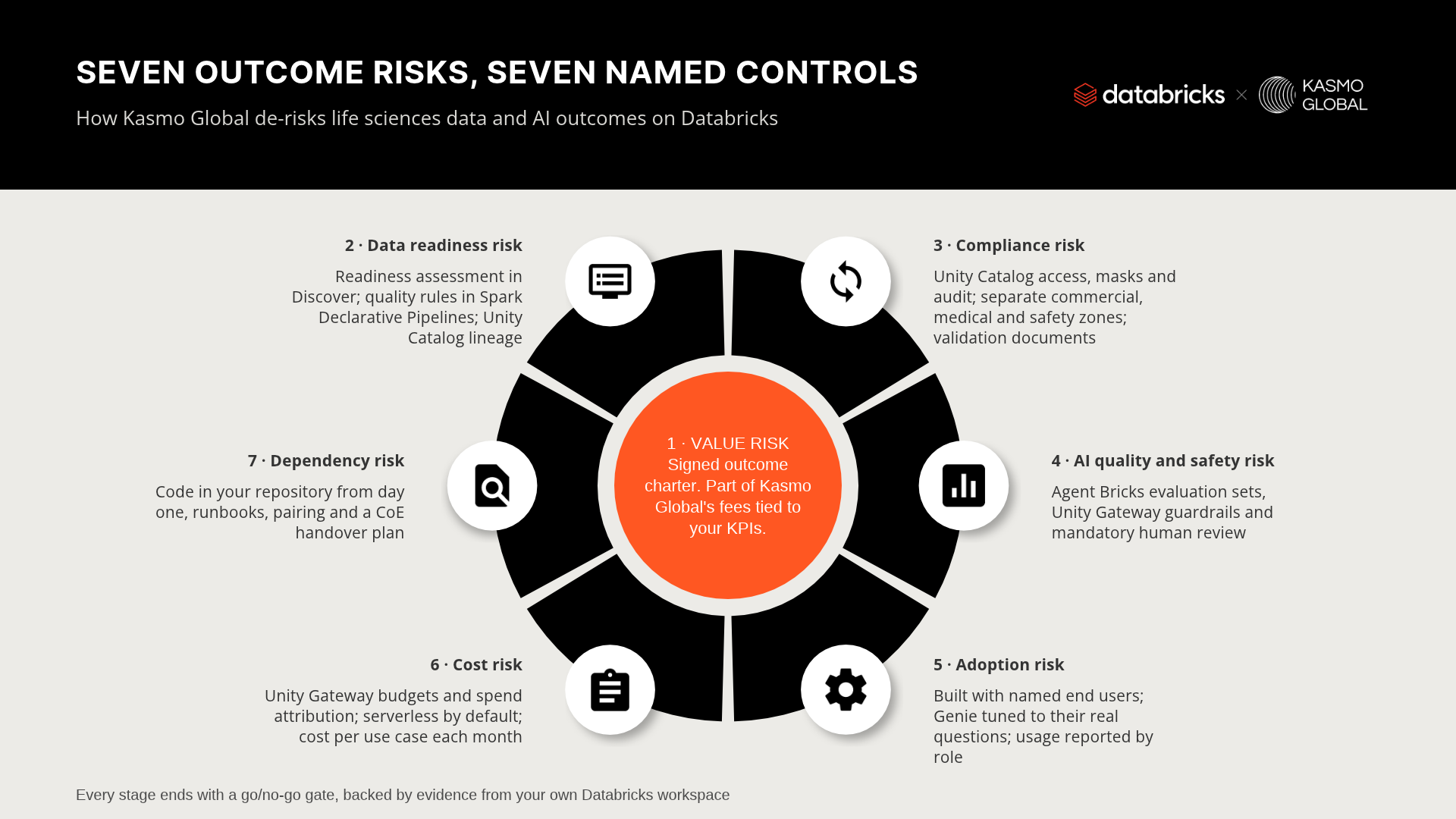
Kasmo Global de-risks life sciences data and AI outcomes by naming the seven ways a use case usually fails before build starts, putting a specific control on each one, and requiring every stage to pass a go/no-go gate with evidence from the customer's own Databricks workspace.
| Outcome risk | Kasmo Global control | Evidence you receive |
|---|---|---|
| 1. Value | Signed outcome charter: KPI, baseline, target and owner agreed before build | Outcome charter and KPI dashboard |
| 2. Data readiness | Readiness assessment in Discover; quality expectations in pipelines | Readiness report and Unity Catalog lineage |
| 3. Compliance | Unity Catalog access controls, masking and audit logs; validation documentation for GxP-relevant systems | Access model, audit trail, validation package |
| 4. AI quality and safety | Expert-built evaluation sets, Unity Gateway guardrails, human review of medical and safety outputs | Evaluation scores against an agreed threshold |
| 5. Adoption | Built with named end users and tuned to the questions they ask | Weekly active users by role |
| 6. Cost | Unity Gateway budgets, rate limits and spend attribution; serverless by default | Cost per use case, monthly |
| 7. Dependency | Code in the customer's repository from day one, runbooks and pairing with internal engineers | Runbooks and a signed handover checklist |
Because part of Kasmo Global's fees is tied to the KPI in the outcome charter, and KPI results are measured from data in the customer's own workspace, Kasmo Global shares the outcome risk and both sides see the same numbers.
Have a use case that needs to reach production? Talk to an FDE lead, or explore how we support pharmaceutical companies.
Frequently asked questions
What is forward deployed engineering in life sciences?
Forward deployed engineering in life sciences is a delivery model in which engineers work inside a pharma, biotech or medtech team and build production data and AI systems with them, rather than advising from outside. Kasmo Global applies this model on the Databricks Data + AI Platform.
How is Kasmo Global FDE different from Databricks Forward Deployed Engineering?
Kasmo Global Life Sciences FDE is a Kasmo Global team that works only on pharma, biotech and medtech use cases on the Databricks Data + AI Platform, with outcome-based fees and Kasmo Global accelerators. Databricks Forward Deployed Engineering is a separate services team run by Databricks.
Does Kasmo Global offer outcome-based pricing?
Yes. In Kasmo Global Life Sciences FDE engagements, part of Kasmo Global's fees are tied to KPIs agreed with the customer at kickoff and recorded in the outcome charter.
Where is the Kasmo Global FDE team based?
All Kasmo Global Life Sciences FDE delivery is from the United States. The team has 15+ Databricks-certified engineers, and Kasmo Global is headquartered in Plano, Texas.
What happens if a use case is not working?
Every Kasmo Global FDE engagement has a go/no-go gate at the end of each stage. If the KPI baseline, data readiness or evaluation results do not meet the agreed criteria, the customer can stop, change the use case or adjust scope at that gate, with the evidence already documented.
Put this into practice with our team
Share what you are working on and we will show how governed data and AI can move your programs forward.
Email marketing@kasmoglobal.com