What Capabilities Matter Most for Biopharma Patient Engagement and Adherence in 2026?
Six ranked capabilities for biopharma patient engagement and adherence in 2026, with recent research and a Databricks reference architecture.

By Nitya, Solution Marketing, Kasmo Global · Published November 8, 2026
Biopharma patient engagement and adherence is the set of data, analytics and outreach capabilities that help patients start and stay on a prescribed therapy: finding where patients drop off between prescription and first fill, supporting them through access and affordability barriers, and reminding and supporting them once therapy starts. Kasmo Global is a life sciences data and AI consulting company and Databricks partner that helps biopharma patient services and brand teams build governed patient journey data and agentic AI on the Databricks Data + AI Platform.
In short
- The six capabilities that matter most in 2026 are: a governed patient journey foundation, drop-off and abandonment detection, real-time patient profiles for digital services, personalized adherence outreach, GenAI patient-support agents with human review, and built-in privacy, consent and AI cost controls.
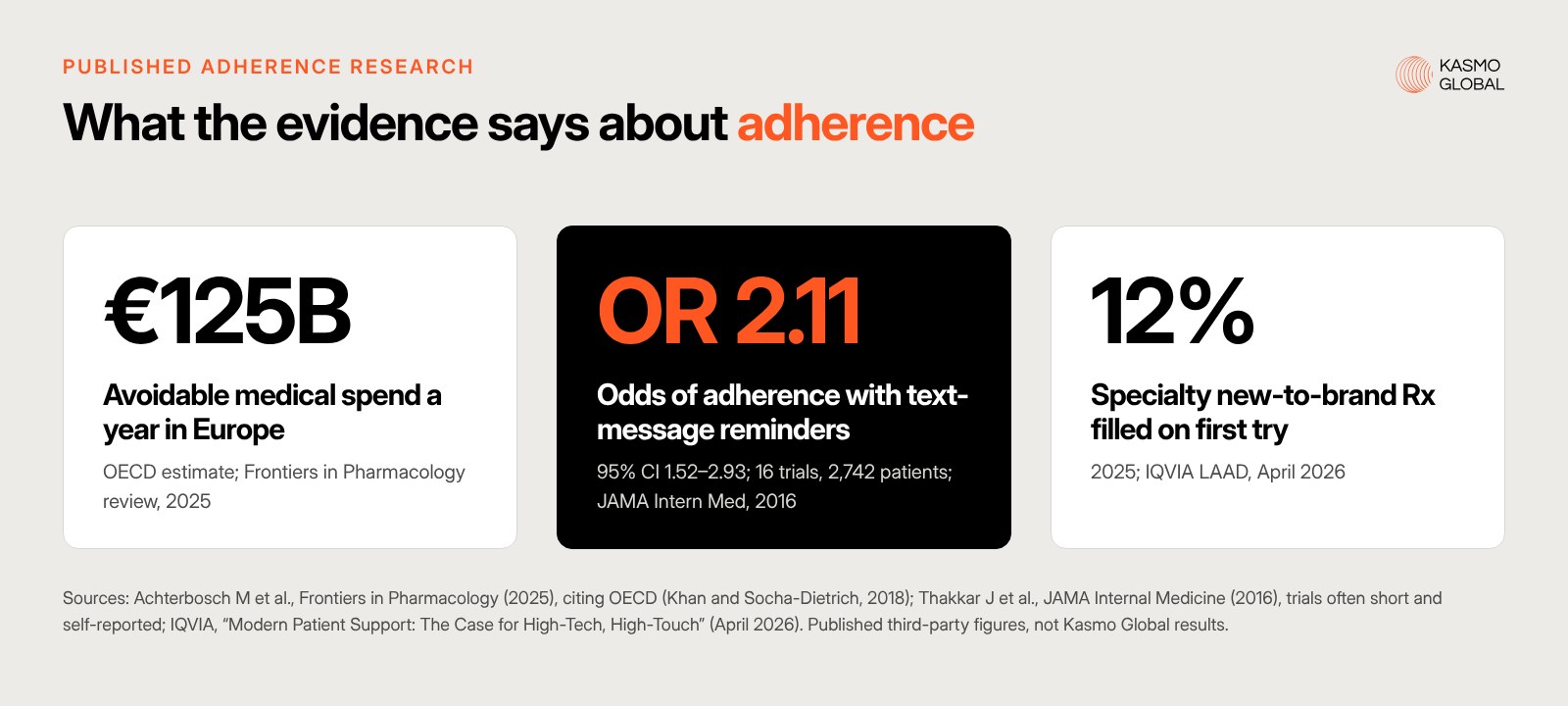
- Nonadherence carries a measurable cost: a 2025 review of 43 systematic reviews in Frontiers in Pharmacology links it to higher mortality and more hospital admissions, and cites an OECD estimate of 200,000 deaths and €125 billion in avoidable medical spending per year in Europe.
- Drop-off often happens before therapy starts: IQVIA reports that in 2025 only 12% of new-to-brand specialty prescriptions were filled on the first try, and that about one in two commercially insured patients did not pick up their medication once out-of-pocket costs reached $125 to $250.
- Outreach can move adherence: a 2016 JAMA Internal Medicine meta-analysis of 16 randomized trials found that text-message interventions doubled the odds of adherence (odds ratio 2.11), with the authors cautioning that many trials were short and used self-reported adherence.
- The figures above are published third-party research, not Kasmo Global results.
What is a biopharma patient engagement and adherence platform?
A biopharma patient engagement and adherence platform is the data and AI layer behind a manufacturer's patient services: it connects hub, specialty pharmacy, claims, copay and digital app data into one governed view of each patient's path from prescription to persistence, then uses that view to trigger support, outreach and reporting. The platform does not replace the hub or the care team; it tells them which patients need help, when, and with what.
Databricks frames this outcome area on its Healthcare and Life Sciences page as "Improve patient engagement and adherence", with Lakebase serving real-time patient profiles, adherence data and connected-device telemetry to digital health apps, and as "Personalize patient engagement", covering targeted outreach, adherence reminders and care plan recommendations.
Why does patient adherence matter to biopharma brand and patient services teams?
Patient adherence matters to biopharma brand and patient services teams because a prescription that is never filled, or a therapy that is stopped early, cannot deliver its intended benefit to the patient or revenue to the brand. A 2025 review of systematic reviews by Achterbosch and colleagues in Frontiers in Pharmacology, covering 43 systematic reviews and more than 410 original studies on clinical outcomes, found medication nonadherence associated with higher mortality and greater healthcare use, including hospital admissions. The same review cites an OECD estimate that nonadherence is associated with 200,000 deaths and €125 billion in avoidable medical expenditure per year in Europe.
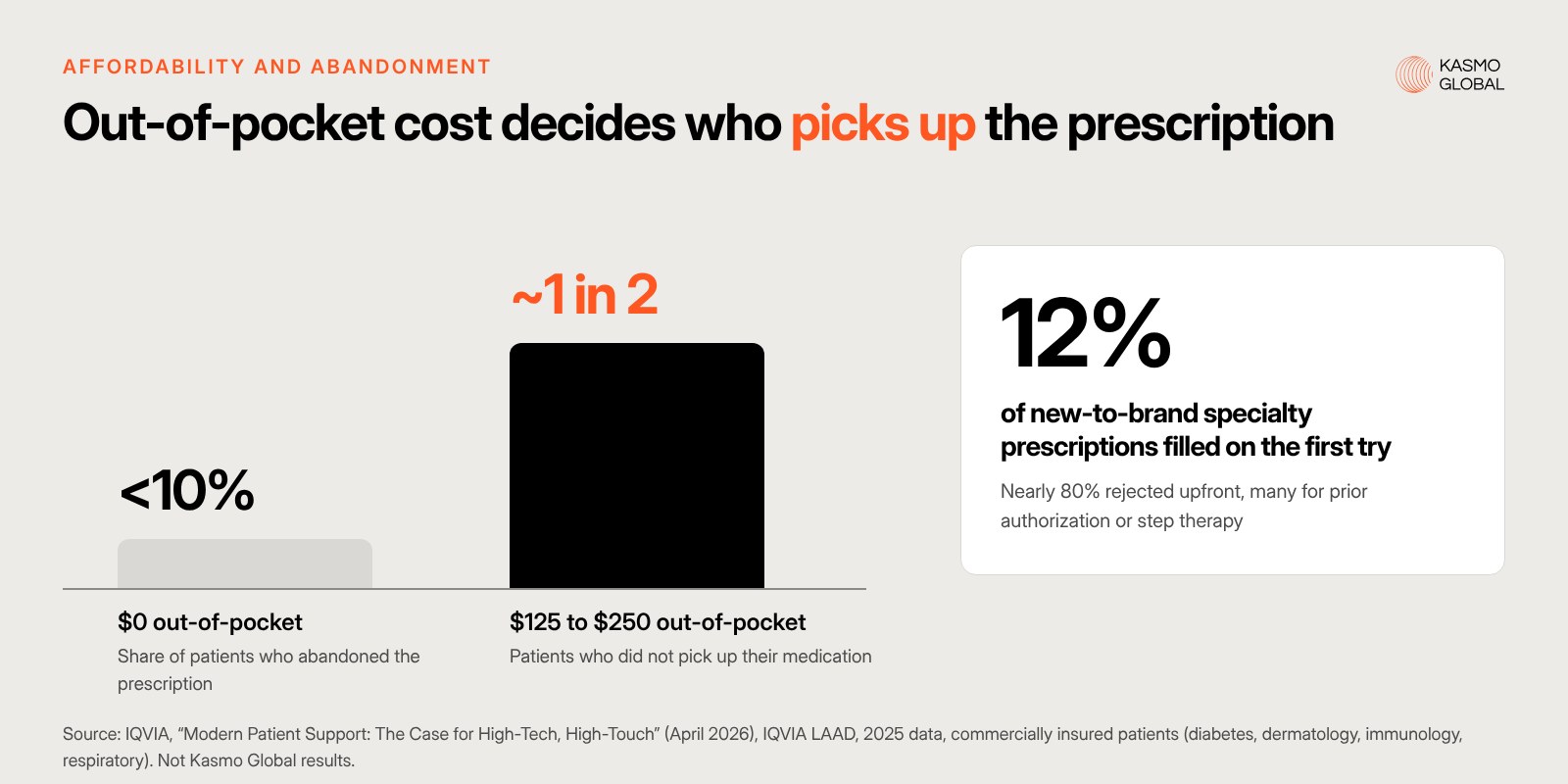
For specialty brands, the largest losses often happen before the first dose. IQVIA's April 2026 article on modern patient support reports, from IQVIA LAAD data, three 2025 findings:
- First fill. Only 12% of new-to-brand specialty prescriptions were successfully filled on the first try, and nearly 80% were rejected upfront, many because of prior authorization or step therapy requirements.
- Affordability at $0. Fewer than 10% of commercially insured patients abandoned their prescription when their out-of-pocket cost was $0, across diabetes, dermatology, immunology and respiratory treatments.
- Affordability at $125 to $250. About one in two commercially insured patients did not pick up their medication once out-of-pocket costs reached $125 to $250.
The three KPIs that patient engagement programs report against are patient adherence rate, conversion rate (prescription to first fill and therapy start) and patient satisfaction.
What are the most important capabilities for biopharma patient engagement and adherence in 2026?
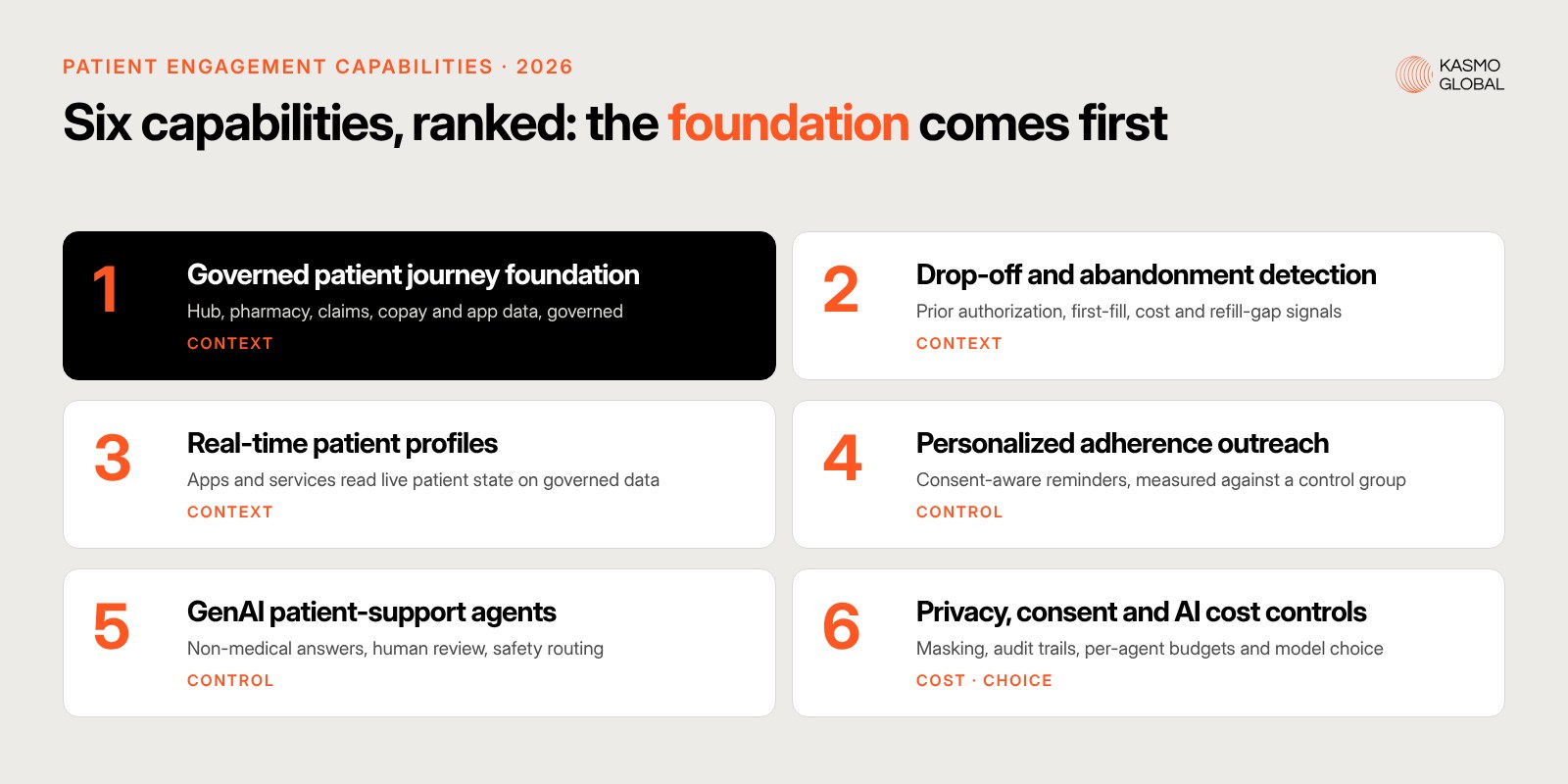
The six most important capabilities for biopharma patient engagement and adherence in 2026, ranked by how much each one determines whether the others work, are: a governed patient journey foundation, drop-off and abandonment detection, real-time patient profiles for digital services, personalized adherence outreach, GenAI patient-support agents with human review, and privacy, consent and AI cost controls. Each maps to one of the four principles Databricks uses for its platform: context, control, cost and choice.
1. A governed patient journey foundation (Context)
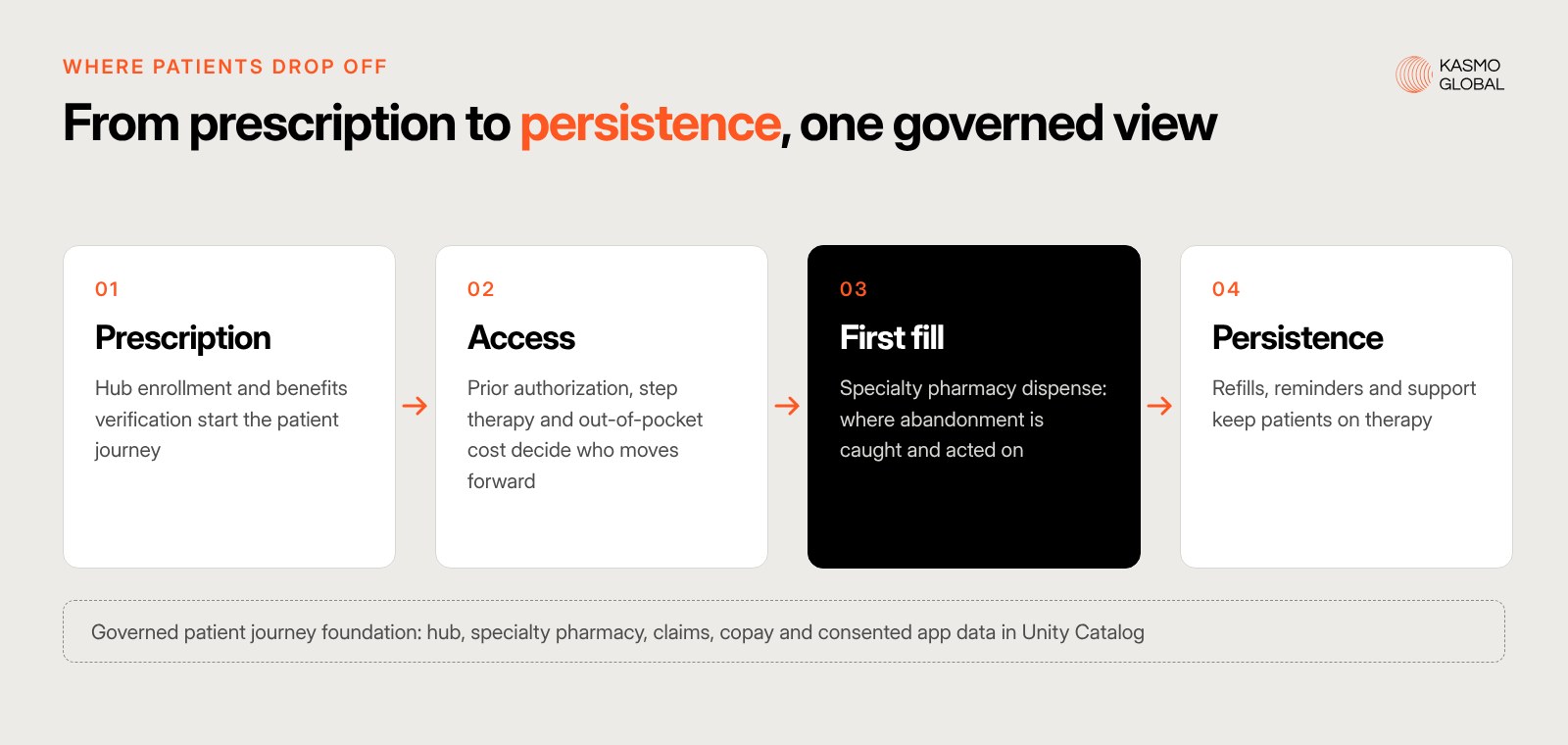
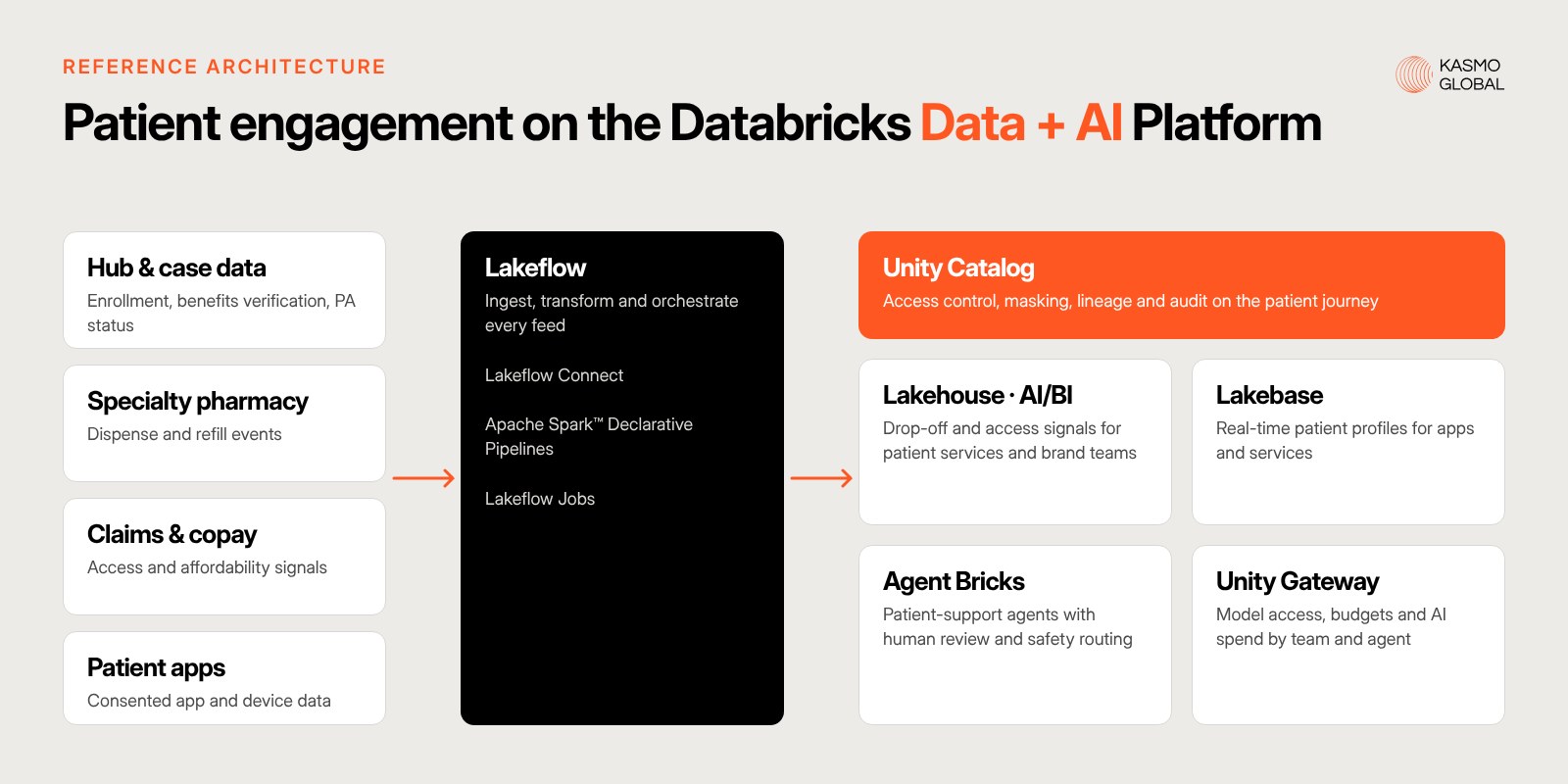
A governed patient journey foundation is one de-identified or consented view of each patient's path, built from hub enrollment, benefits verification, prior authorization status, specialty pharmacy dispense, copay program and digital app data. Without it, the hub, the specialty pharmacy and the brand team each see a fragment, and no one can say where a given patient stalled. On Databricks, Lakeflow brings these feeds in and Unity Catalog governs who sees which fields, with lineage back to each source.
2. Drop-off and abandonment detection (Context)
Drop-off and abandonment detection identifies patients who are stuck between prescription and therapy start, or who are late for a refill, early enough for patient services to act. The signals that matter are a pending or denied prior authorization, a rejected first fill, a high out-of-pocket cost with no copay support applied, and a widening gap since the last dispense. The IQVIA 2025 figures on first-fill rejection and cost-driven abandonment show why these signals belong at the top of the list.
3. Real-time patient profiles for digital services (Context)
Real-time patient profiles let a patient app, a scheduling service or a support chatbot read and update a patient's current state, such as the next refill date, the last reminder sent or a connected-device reading, while the patient is still in the session rather than after a nightly batch. Databricks positions Lakebase for this pattern on its Healthcare and Life Sciences page: serving real-time patient profiles, adherence data and connected-device telemetry to digital health apps, on the same governed platform as analytics.
4. Personalized adherence outreach (Control)
Personalized adherence outreach sends the right reminder, refill nudge or support offer to each patient through the channel that patient has consented to, and records whether it worked. The evidence that simple outreach can move adherence is published: a 2016 meta-analysis by Thakkar and colleagues in JAMA Internal Medicine, covering 16 randomized trials and 2,742 patients with chronic conditions, found that text-message interventions significantly improved adherence (odds ratio 2.11; 95% CI, 1.52–2.93), equivalent to raising a typical 50% adherence rate to 67.8%. The authors cautioned that many of the trials were short and relied on self-reported adherence.
5. GenAI patient-support agents with human review (Control)
GenAI patient-support agents answer routine, non-medical questions, such as refill timing, copay program steps or how to reach the specialty pharmacy, and draft case notes for hub staff, while routing any medical or safety question to a qualified person. Human review is the design requirement: the agent drafts and triages, and patient services staff decide. Any mention of a possible adverse event goes to the manufacturer's pharmacovigilance process rather than being handled by the agent. On Databricks, Agent Bricks builds, evaluates and monitors these agents on governed data.
6. Privacy, consent and AI cost controls (Control, Cost, Choice)
Privacy, consent and AI cost controls keep patient data inside the uses each patient agreed to and keep AI spend predictable. That means consent status attached to every record and checked before outreach, patient-level data masked from commercial users, audit trails on every access, and budgets and model choice set per agent. Unity Catalog covers access control, lineage and audit, and Unity Gateway sets budgets, rate limits and spend attribution by team and agent across proprietary and open models.
How do the six capabilities compare?
The six patient engagement capabilities differ in the KPI each one moves and the Databricks Data + AI Platform component that supports it. The table below is a checklist buyers can use to assess a vendor, a partner or an in-house program.
| Rank | Capability | What to look for | KPI it moves | Databricks component |
|---|---|---|---|---|
| 1 | Governed patient journey foundation | Hub, specialty pharmacy, claims, copay and app data linked per patient, with consent and lineage | All three (prerequisite) | Lakeflow, Unity Catalog |
| 2 | Drop-off and abandonment detection | Alerts on prior authorization delays, first-fill rejections, high out-of-pocket cost and late refills | Conversion rate | Lakehouse, AI/BI |
| 3 | Real-time patient profiles | Low-latency reads and updates for apps, scheduling and chat on the same governed data | Adherence rate, satisfaction | Lakebase |
| 4 | Personalized adherence outreach | Consent-aware reminders and refill nudges, with response tracked against a control group | Adherence rate | Agent Bricks, Lakebase |
| 5 | GenAI patient-support agents with human review | Non-medical answers only, medical and safety questions routed to people, evaluations before release | Satisfaction, conversion rate | Agent Bricks |
| 6 | Privacy, consent and AI cost controls | Field-level masking, audit trails, per-agent budgets and model choice | Program risk and cost | Unity Catalog, Unity Gateway |
What results can biopharma teams expect from better patient engagement?
Biopharma teams can expect patient engagement results to depend on where their patients drop off today, so published research gives direction rather than a promise. The figures below come from named third-party sources, are not Kasmo Global results, and each carries the qualifiers its source states.
| Finding | Figure | Qualifiers | Source |
|---|---|---|---|
| Cost of nonadherence in Europe | 200,000 deaths and €125 billion avoidable medical expenditure per year | OECD estimate (Khan and Socha-Dietrich, 2018), cited in a review of 43 systematic reviews | Achterbosch et al., Frontiers in Pharmacology, 2025 |
| Adherence with text-message interventions | Odds ratio 2.11 (95% CI, 1.52–2.93); about 50% raised to 67.8% | 16 randomized trials, 2,742 patients; short, often self-reported studies | Thakkar et al., JAMA Internal Medicine, 2016 |
| First-fill success, specialty new-to-brand | 12% filled on first try | 2025; nearly 80% rejected upfront | IQVIA, April 2026 (IQVIA LAAD) |
| Abandonment at $0 out-of-pocket | Fewer than 10% | 2025; commercially insured; diabetes, dermatology, immunology, respiratory | IQVIA, April 2026 (IQVIA LAAD) |
| Abandonment at $125 to $250 out-of-pocket | About one in two patients | 2025; commercially insured | IQVIA, April 2026 (IQVIA LAAD) |
Programs should measure their own lift against a matched control group, using a defined adherence measure such as proportion of days covered, so the result holds up with brand leadership and finance.
How does Kasmo Global approach patient engagement on Databricks?
Kasmo Global approaches patient engagement on the Databricks Data + AI Platform data first and agents second: Lakeflow brings in hub, specialty pharmacy, claims and copay data, Unity Catalog governs the patient journey with masking and lineage, the Lakehouse and AI/BI surface drop-off and access signals, Lakebase serves real-time patient profiles to digital services, Agent Bricks hosts patient-support agents that work under human review, and Unity Gateway controls model access and AI spend. Kasmo Global's view is that most adherence programs stall on the first capability, not the last, so the foundation comes before any agent.
Lakebase. Databricks Lakebase Postgres is a fully managed, serverless Postgres service that separates compute from storage, so operational workloads run directly on the Databricks Data + AI Platform with the same governance and security as analytics and AI. It supports serverless autoscaling and scale to zero, instant zero-copy database branching, point-in-time recovery, and unified governance through Unity Catalog. Learn more: Lakebase product page
Unity Catalog. Databricks Unity Catalog is the unified governance layer for data and AI assets on Databricks, covering access control, discovery, business semantics, lineage, quality monitoring and open sharing across tables, files, models, agents, skills and MCP tools. Learn more: Unity Catalog product page
Agent Bricks. Agent Bricks is an open agent developer platform for building, deploying and optimizing custom agents on any model, framework or harness, with all your data. It is powered by Omnigent, a multi-harness agent development platform, and includes AI search, memory, sandboxing, evaluations, observability and monitoring. Learn more: Agent Bricks product page
Unity Gateway. Unity Gateway is the enterprise AI control plane for accessing, managing and optimizing AI across every team, application, model and agent. It provides reliable capacity across leading proprietary and open models through a single gateway, Smart Routing that directs each request to the best-fit model for cost, quality and performance, and budgets, rate limits and spend attribution by user, team, agent and model. Access policies, guardrails and audit trails span models, agents, MCPs and tools. Learn more: Unity Gateway product page
Patient journey data also informs commercial teams: when access barriers cluster around certain prescribers or accounts, that context can reach field teams at an aggregated level, with patient-level data kept out of the field view. For the provider side of the same commercial picture, see What Is AI Next Best Action for Biopharma Commercial Teams?
Which approach is right for your patient services program?
The right approach for a biopharma patient services program depends on where its data and drop-off problem sit today. Use this guide:
- Hub, specialty pharmacy and copay data are not yet linked. Start with capability 1, the governed patient journey foundation. Nothing downstream is reliable without it.
- Data is linked but patients still stall before first fill. Prioritize capability 2, drop-off and abandonment detection, focused on prior authorization and out-of-pocket cost signals.
- A patient app or digital service is live or planned. Add capability 3, real-time patient profiles on Lakebase, so the app and the analytics read the same governed data.
- Patients start therapy but persistence falls off. Invest in capability 4, personalized adherence outreach, measured against a control group.
- Hub staff are stretched by routine questions. Pilot capability 5, a GenAI patient-support agent with human review and medical-safety routing switched on from day one.
Want to see where patients drop off in your program? Book an AI assessment with Kasmo Global, or explore how we support pharmaceutical companies.
Frequently asked questions
What is patient engagement in biopharma?
Patient engagement in biopharma is the set of manufacturer-run services, data and outreach that help patients start and stay on a prescribed therapy, including hub services, benefits verification, copay support, adherence reminders, digital apps and patient-support lines.
What is the difference between medication adherence and persistence?
Medication adherence measures whether a patient takes a therapy as prescribed, often as proportion of days covered; persistence measures how long a patient stays on therapy before stopping. A patient can be persistent but poorly adherent, so programs track both.
Why do patients abandon specialty prescriptions?
Patients abandon specialty prescriptions mainly because of access and affordability barriers. IQVIA reports that in 2025 nearly 80% of new-to-brand specialty prescriptions were rejected upfront, many due to prior authorization or step therapy, and that about one in two commercially insured patients did not pick up their medication once out-of-pocket costs reached $125 to $250.
What does medication nonadherence cost?
A 2025 review of 43 systematic reviews in Frontiers in Pharmacology associates medication nonadherence with higher mortality and more hospital admissions, and cites an OECD estimate of 200,000 deaths and €125 billion in avoidable medical expenditure per year in Europe.
Do adherence reminders improve adherence?
Published evidence suggests adherence reminders can help. A 2016 JAMA Internal Medicine meta-analysis of 16 randomized trials found text-message interventions doubled the odds of adherence (odds ratio 2.11), although the authors noted many trials were short and used self-reported adherence.
What data does a patient engagement and adherence platform need?
A patient engagement and adherence platform needs hub enrollment and case data, benefits verification and prior authorization status, specialty pharmacy dispense data, copay program data, claims, digital app and device data where consented, and each patient's consent and channel preferences.
Can GenAI agents talk to patients safely?
GenAI agents can support patients safely when they are limited to non-medical questions such as refill timing or copay steps, route every medical or safety question to a qualified person, send possible adverse events to pharmacovigilance, and are evaluated before release and monitored after. Human review of agent output is the core control.
Why run patient engagement on the Databricks Data + AI Platform?
Running patient engagement on the Databricks Data + AI Platform keeps the patient journey, the analytics, the real-time app data and the agents on one governed copy of the data: Unity Catalog governs access, masking and lineage, Lakebase serves real-time patient profiles, Agent Bricks builds and monitors patient-support agents, and Unity Gateway controls model access and AI spend.
How does Kasmo Global help biopharma teams with patient engagement?
Kasmo Global, a life sciences data and AI consulting company and Databricks partner, helps biopharma patient services and brand teams build the governed patient journey foundation first, then add drop-off detection, real-time profiles and human-reviewed patient-support agents on the Databricks Data + AI Platform.
Sources
- Achterbosch M et al. Clinical and economic consequences of medication nonadherence: a review of systematic reviews. Frontiers in Pharmacology, 2025; doi:10.3389/fphar.2025.1570359 (per a March 2026 correction, the journal publication fee was paid by Abbott Pharmaceuticals Ltd., which was not involved in the study)
- Thakkar J et al. Mobile Telephone Text Messaging for Medication Adherence in Chronic Disease: A Meta-analysis. JAMA Internal Medicine, 2016;176(3):340–349; doi:10.1001/jamainternmed.2015.7667
- IQVIA: Modern Patient Support: The Case for High-Tech, High-Touch (April 2026)
- Databricks for Healthcare and Life Sciences
Put this into practice with our team
Share what you are working on and we will show how governed data and AI can move your programs forward.
Email marketing@kasmoglobal.com