What Capabilities Matter Most for AI Drug Discovery in 2026?
Six capabilities that matter most for AI drug discovery in 2026, ranked, with published research and a reference architecture on Databricks.

By Nitya, Solution Marketing, Kasmo Global · Published November 14, 2026
AI drug discovery is the use of machine learning, foundation models and AI agents in early pharmaceutical research, and in 2026 six capabilities matter most: a FAIR research data foundation, genetics-led target identification, molecular property prediction and design, imaging and assay AI, scientific AI agents with human review, and governance and AI cost controls. Kasmo Global is a life sciences data and AI consulting company and Databricks partner that helps biopharma and biotech R&D teams choose better targets and candidates faster on the Databricks Data + AI Platform.
In short
- The six capabilities that matter most for AI drug discovery in 2026 are: a FAIR, governed multimodal research data foundation; genetics-led target identification; molecular property prediction and design; imaging and assay AI; scientific AI agents with human review; and governance, reproducibility and AI cost controls.
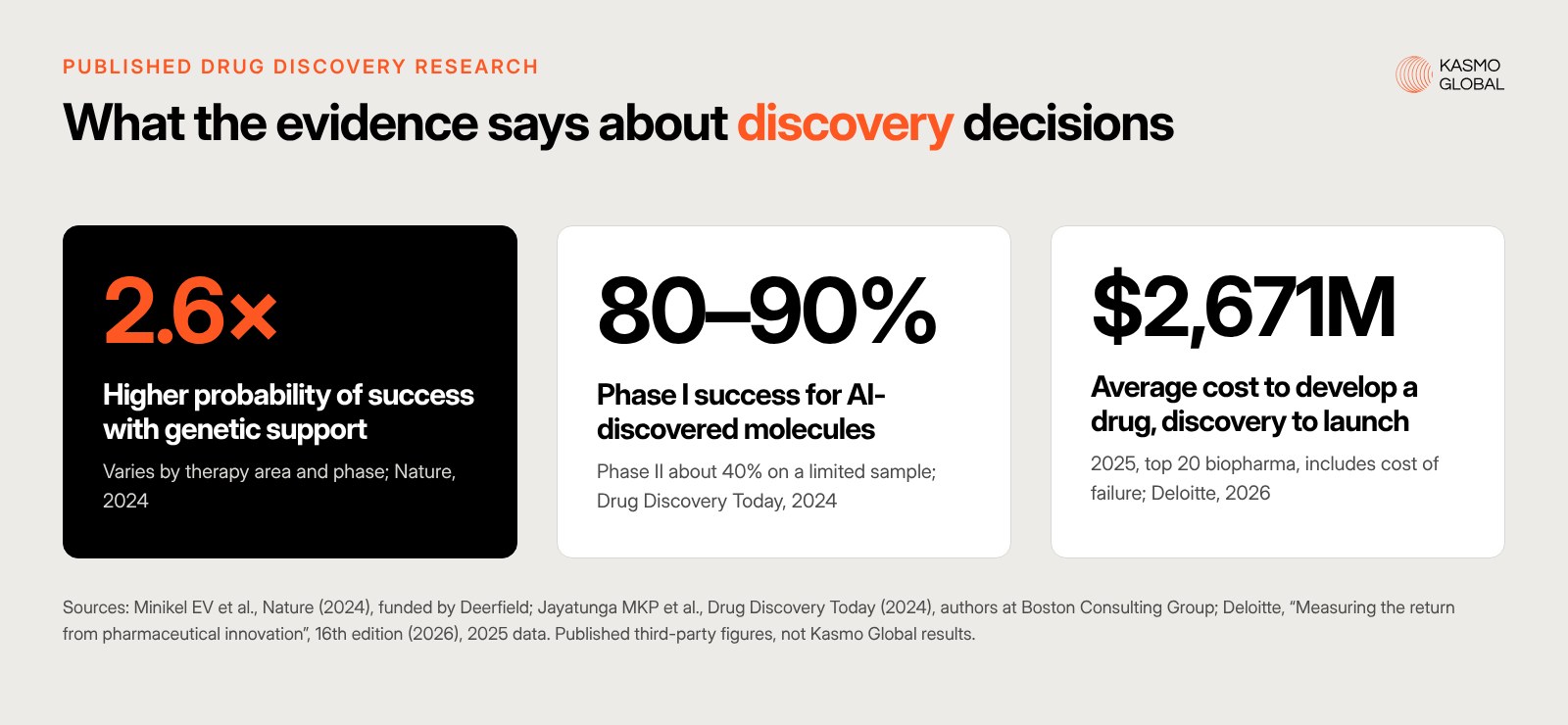
- Genetic evidence is a well-documented signal for target choice: a 2024 Nature analysis estimated that drug mechanisms with genetic support are 2.6 times more likely to succeed than those without, with results varying by therapy area and phase.
- Early clinical results for AI-discovered molecules are encouraging: a 2024 Drug Discovery Today analysis reported an 80-90% Phase I success rate, and about 40% in Phase II on a limited sample, comparable to historic averages.
- The cost of getting it wrong keeps rising: Deloitte reports the average cost to develop a drug from discovery to launch reached $2,671 million in 2025 for the top 20 biopharma companies, including the cost of failure.
- The figures above are published third-party research, not Kasmo Global results.
What is AI drug discovery?
AI drug discovery is the application of machine learning, foundation models and AI agents to the earliest stages of pharmaceutical R&D: identifying and validating targets, designing and prioritizing molecules, reading images and assay results, and synthesizing evidence from the literature. AI drug discovery does not replace the lab; it narrows the set of hypotheses the lab has to test and makes earlier experiments reusable for the next program.
Databricks frames this outcome area on its Healthcare and Life Sciences page as "Accelerate drug discovery": training multimodal models on multi-omics, imaging and scientific data, then letting scientists query that data in plain English with Genie. The same page describes building a FAIR data foundation with Unity Catalog lineage spanning omics, imaging and trials.
The two KPIs discovery leaders report against are target identification success rate and R&D cost per successful molecule. Typical use cases include genetic target identification, QSAR (quantitative structure-activity relationship) modeling, single-cell and network biology models such as Geneformer, image classification such as digital pathology, and chromatography and other analytical data insights.
Why does AI drug discovery matter to biopharma and biotech R&D leaders?
AI drug discovery matters to R&D leaders because most of the cost of a new medicine is the cost of programs that fail, and the decisions that set up those failures are made in discovery. Deloitte's 2026 edition of Measuring the return from pharmaceutical innovation, covering the top 20 biopharma companies by R&D spend, reports that the average cost to develop a drug from discovery to launch grew to $2,671 million in 2025, from $2,229 million in 2024. Deloitte's cost figure includes the cost of failure.
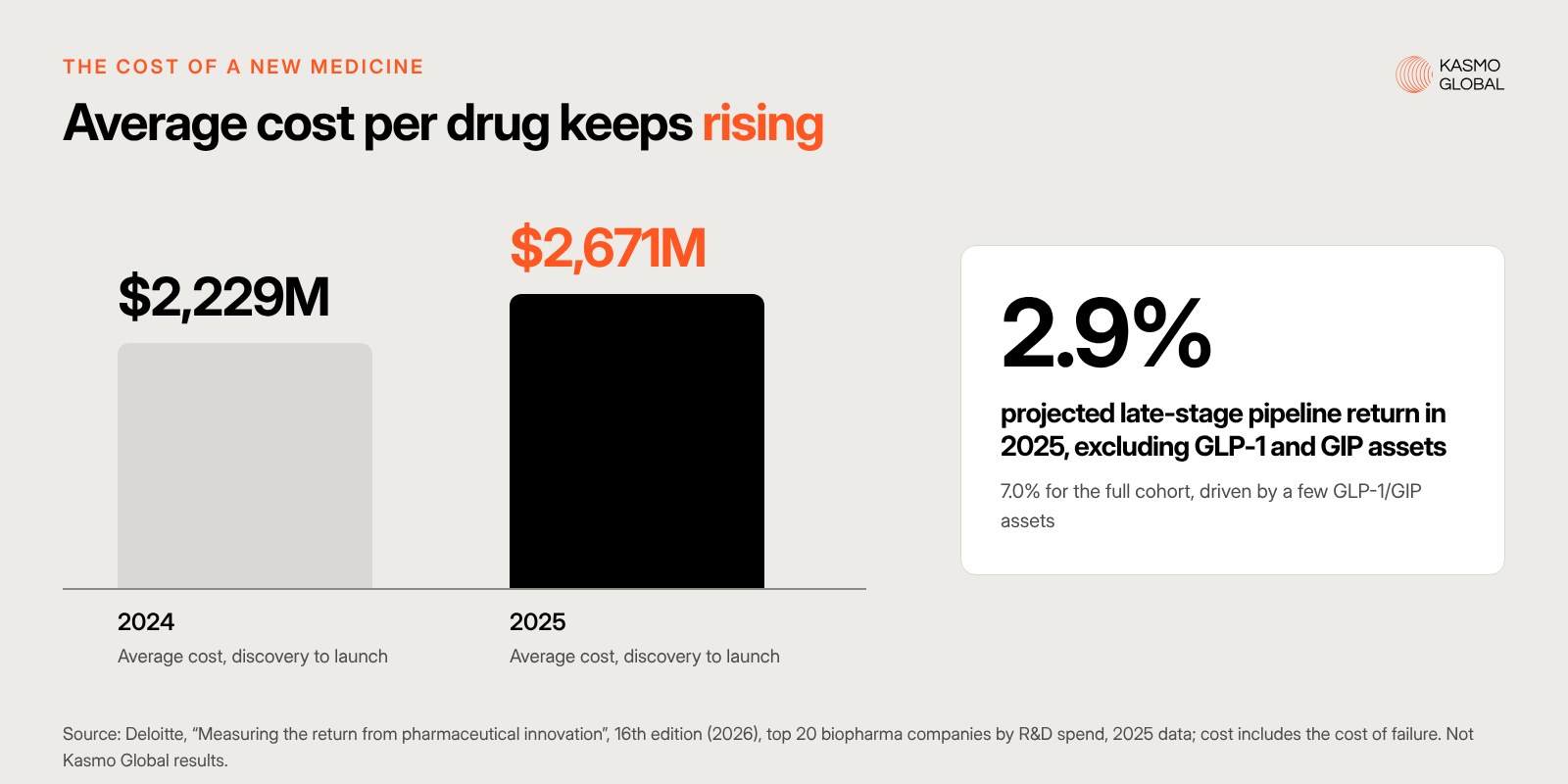
The same Deloitte report shows how concentrated recent returns are: the projected internal rate of return on late-stage pipelines rose to 7.0% in 2025, but excluding GLP-1 and GIP assets the rate of return was 2.9%. For discovery teams outside those categories, choosing better targets and candidates earlier is the main lever on cost per successful molecule.
What are the most important capabilities for AI drug discovery in 2026?
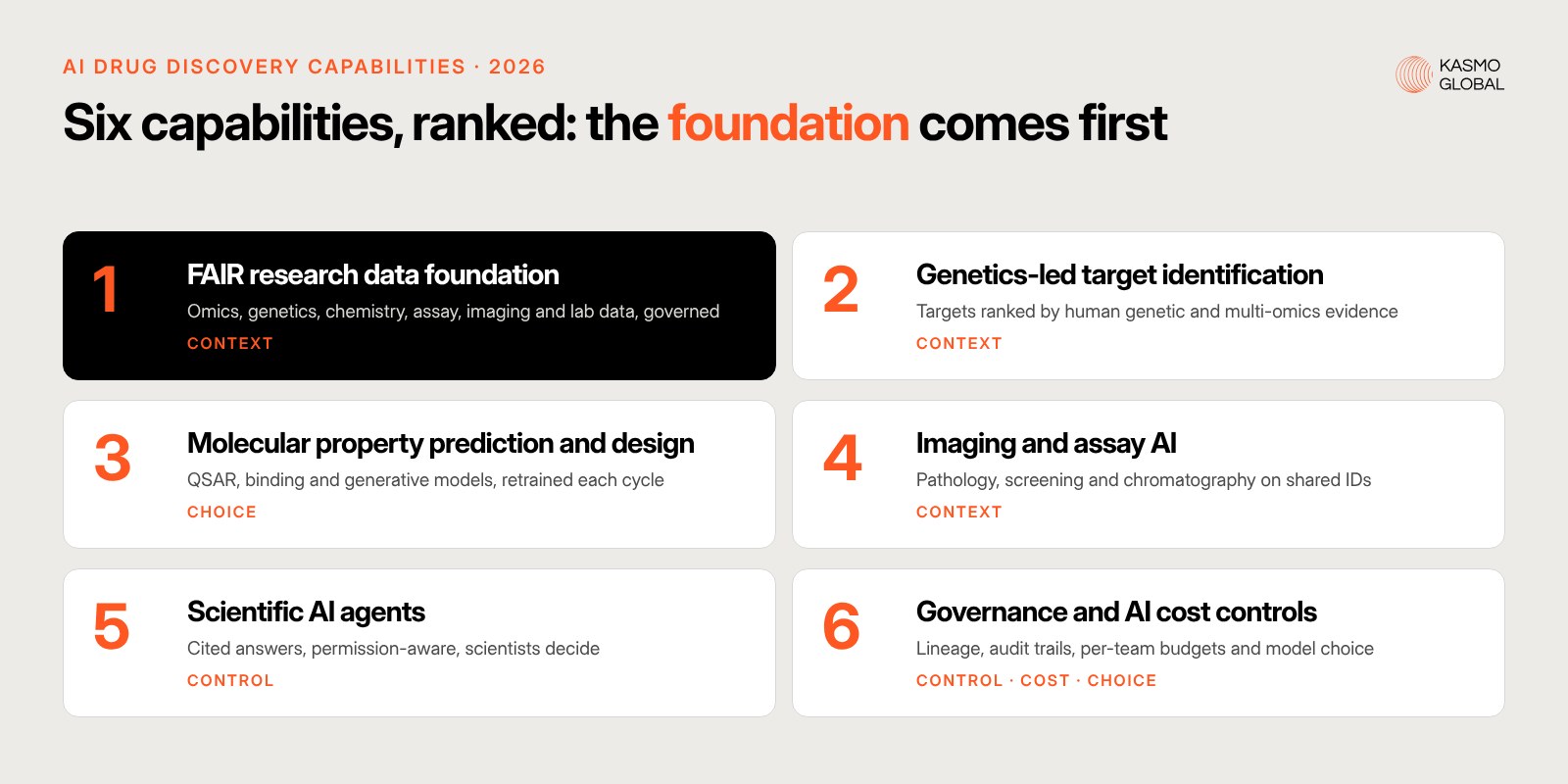
The six most important capabilities for AI drug discovery in 2026, ranked by how much each one determines whether the others work, are: a FAIR, governed multimodal research data foundation; genetics-led target identification; molecular property prediction and design; imaging and assay AI; scientific AI agents with human review; and governance, reproducibility and AI cost controls. Each maps to one of the four principles Databricks uses for its platform: context, control, cost and choice.
1. A FAIR, governed multimodal research data foundation (Context)
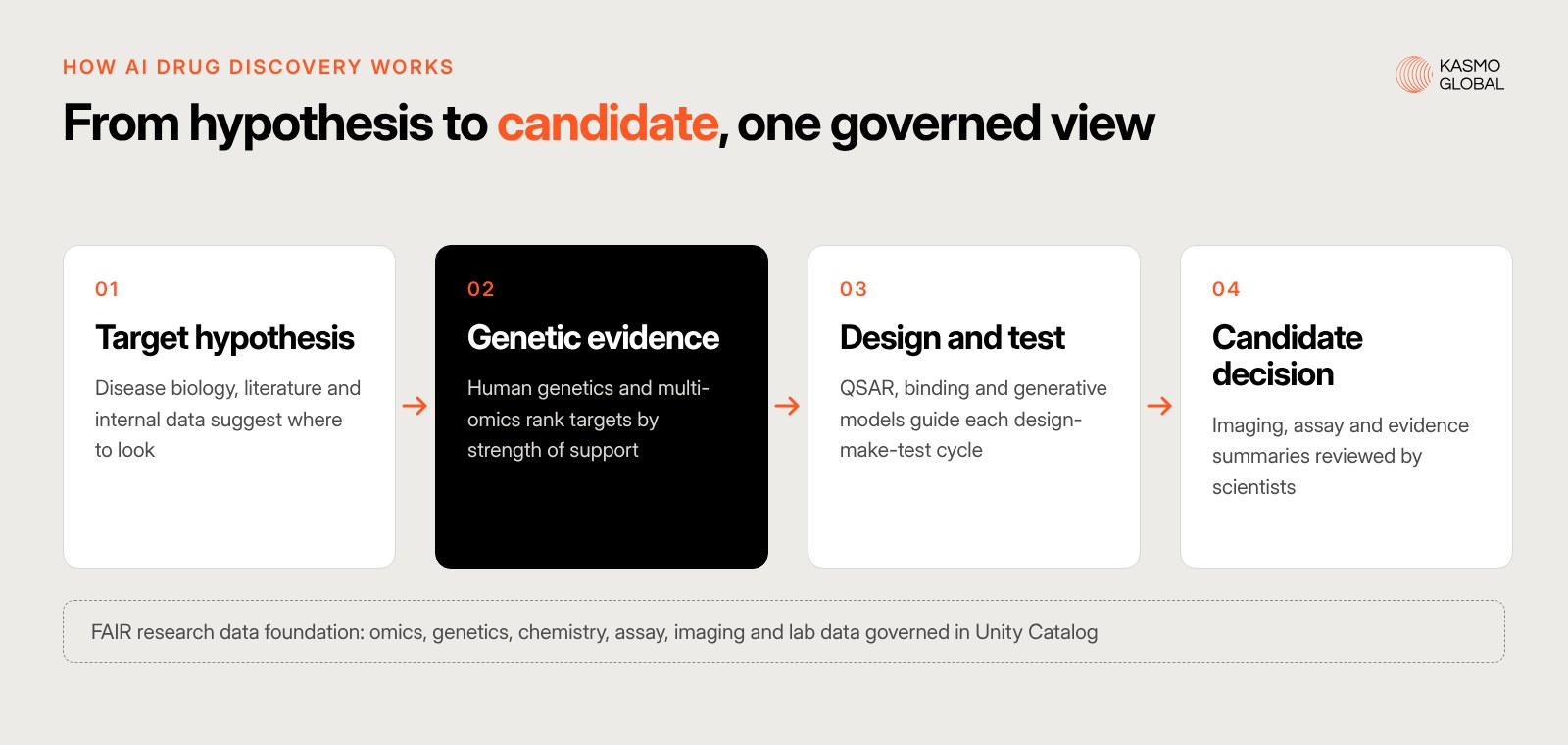
A FAIR, governed multimodal research data foundation is one findable, accessible, interoperable and reusable view of a company's discovery data: multi-omics and single-cell data, genetic evidence, chemical structures and assay results, imaging, chromatography and other analytical data, and electronic lab notebook and LIMS records. Without it, every model starts with weeks of data wrangling and every program re-runs experiments another team has already done. On Databricks, Lakeflow brings these feeds in and Unity Catalog governs access with lineage back to each instrument, lab system or external source.
2. Genetics-led target identification (Context)
Genetics-led target identification ranks candidate targets by the strength of human genetic and multi-omics evidence linking them to disease. The published evidence for this capability is strong: a 2024 Nature analysis by Minikel and colleagues, covering 29,476 target-indication pairs from Citeline Pharmaprojects programs added since 2000, estimated that the probability of success for drug mechanisms with genetic support is 2.6 times greater than for those without. The authors report that this relative success varies among therapy areas and development phases, improves with confidence in the causal gene, and was highest for Mendelian evidence from OMIM (relative success 3.7). Single-cell foundation models such as Geneformer (Theodoris et al., Nature, 2023) extend this work into network biology.
3. Molecular property prediction and design (Choice)
Molecular property prediction and design covers QSAR models, structure and binding prediction, and generative chemistry that propose and rank molecules before they are synthesized. The value comes from closing the loop: each new assay result feeds back into the models, so the next design cycle starts from better data. Because model families change quickly, discovery teams need the choice to train their own models, use open models and call proprietary models side by side on the same governed data.
4. Imaging and assay AI (Context)
Imaging and assay AI classifies digital pathology slides and high-content screening images, flags anomalies in plate and assay data, and extracts patterns from chromatography and other analytical runs. These datasets are large and often stored in instrument-specific formats, so this capability depends on capability 1: images and results have to be registered to the same compound, sample and experiment identifiers as the rest of the research data.
5. Scientific AI agents with human review (Control)
Scientific AI agents search the literature and public databases, answer questions over internal research data in plain English, and draft evidence summaries for target and candidate reviews. Databricks describes one such pattern, AiChemy, as a multi-agent assistant that combines external MCP servers such as OpenTargets, PubChem and PubMed with a company's own chemical libraries on Databricks, built with Agent Bricks, Genie and Unity Catalog. Human review is the design requirement: agents cite their sources, read only data the user is permitted to see, and scientists make the decisions.
6. Governance, reproducibility and AI cost controls (Control, Cost, Choice)
Governance, reproducibility and AI cost controls make discovery results traceable and AI spend predictable. That means lineage from every model prediction back to the data and code that produced it, access controls for partner, licensed and patient-derived data, audit trails on agent and model use, and budgets and model choice set per team and per agent. Unity Catalog covers access control, lineage and audit, and Unity Gateway sets budgets, rate limits and spend attribution across proprietary and open models.
How do the six capabilities compare?
The six AI drug discovery capabilities differ in the KPI each one moves and the Databricks Data + AI Platform component that supports it. The table below is a checklist R&D leaders can use to assess a vendor, a partner or an in-house program.
| Rank | Capability | What to look for | KPI it moves | Databricks component |
|---|---|---|---|---|
| 1 | FAIR, governed multimodal research data foundation | Omics, genetics, chemistry, assay, imaging, analytical and ELN/LIMS data linked by shared identifiers, with lineage | Both (prerequisite) | Lakeflow, Unity Catalog |
| 2 | Genetics-led target identification | Targets ranked by human genetic and multi-omics evidence, with confidence in the causal gene shown | Target identification success rate | Lakehouse, Agent Bricks |
| 3 | Molecular property prediction and design | QSAR, binding and generative models retrained on each new assay cycle; open and proprietary models side by side | R&D cost per successful molecule | Agent Bricks, Unity Gateway |
| 4 | Imaging and assay AI | Pathology, high-content screening and chromatography data registered to the same compound and sample IDs | R&D cost per successful molecule | Lakeflow, Lakehouse |
| 5 | Scientific AI agents with human review | Cited answers over literature and internal data, permission-aware, evaluated before release | Target identification success rate | Agent Bricks, Genie One |
| 6 | Governance, reproducibility and AI cost controls | Lineage from prediction to data, partner-data controls, audit trails, per-team AI budgets and model choice | Program risk and cost | Unity Catalog, Unity Gateway |
What does published research say about AI and evidence-led drug discovery?
Published research gives AI drug discovery direction rather than a promise: genetic evidence is linked to higher success, early clinical results for AI-discovered molecules are encouraging on small samples, and the cost of failure keeps rising. The figures below come from named third-party sources, are not Kasmo Global results, and each carries the qualifiers its source states.
| Finding | Figure | Qualifiers | Source |
|---|---|---|---|
| Success with genetic support | 2.6 times greater probability of success for drug mechanisms with genetic support | 29,476 target-indication pairs (Citeline Pharmaprojects, programs added since 2000); varies by therapy area and phase; improves with confidence in the causal gene | Minikel et al., Nature, 2024 |
| Success with Mendelian (OMIM) support | Relative success 3.7 | Highest of the genetic evidence sources examined | Minikel et al., Nature, 2024 |
| Phase I success, AI-discovered molecules | 80-90% | Described as substantially higher than historic industry averages | Jayatunga et al., Drug Discovery Today, 2024 |
| Phase II success, AI-discovered molecules | About 40% | Limited sample size; comparable to historic industry averages | Jayatunga et al., Drug Discovery Today, 2024 |
| Average cost to develop a drug, discovery to launch | $2,671 million in 2025 (from $2,229 million in 2024) | Top 20 biopharma companies by R&D spend; includes the cost of failure | Deloitte, Measuring the return from pharmaceutical innovation, 16th edition, 2026 |
| Projected late-stage pipeline IRR | 7.0% in 2025; 2.9% excluding GLP-1 and GIP assets | Same top 20 cohort; driven by a few GLP-1/GIP assets | Deloitte, 16th edition, 2026 |
R&D teams should measure their own results against a defined baseline, such as the share of targets that pass validation or the number of design cycles per candidate, so the impact of AI holds up with R&D leadership and finance.
How does Kasmo Global approach AI drug discovery on Databricks?
Kasmo Global approaches AI drug discovery on the Databricks Data + AI Platform data first and agents second: Lakeflow brings in omics, chemistry, assay, imaging and lab system data, Unity Catalog governs that research data with lineage, the Lakehouse runs target-evidence and assay analytics, Genie One answers scientists' plain-English questions on governed data, Agent Bricks builds and evaluates research agents that work under human review, and Unity Gateway controls model access and AI spend. Kasmo Global's view is that most discovery AI programs stall on the first capability, not the last, so the FAIR foundation comes before any agent.
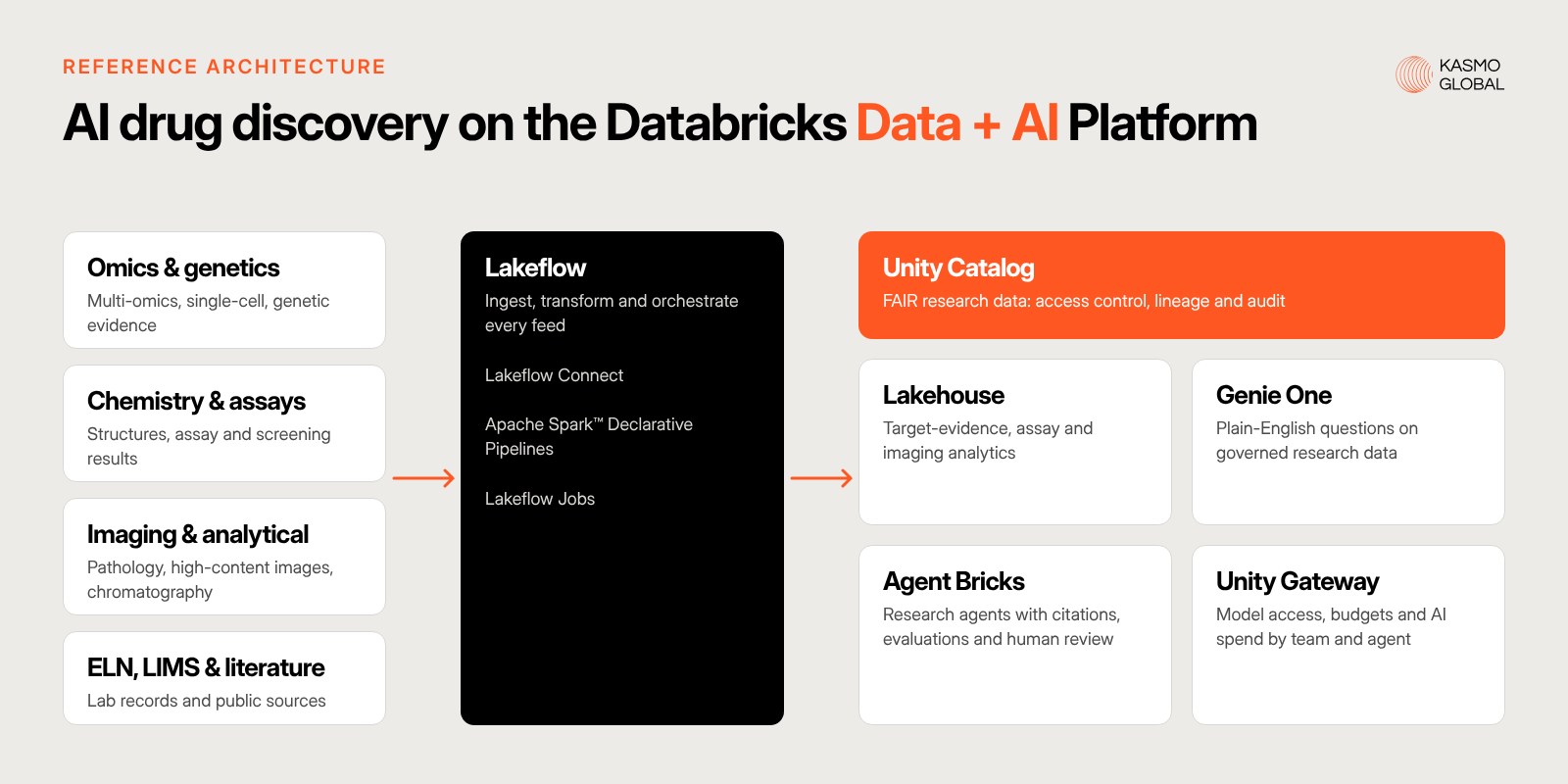
Lakeflow. Databricks Lakeflow is a unified data engineering solution built natively into the Databricks Data + AI Platform. It combines managed ingestion (Lakeflow Connect), declarative pipeline development (Apache Spark™ Declarative Pipelines), and workflow orchestration (Lakeflow Jobs) for batch and streaming pipelines. Learn more: Lakeflow product page
Unity Catalog. Databricks Unity Catalog is the unified governance layer for data and AI assets on Databricks, covering access control, discovery, business semantics, lineage, quality monitoring and open sharing across tables, files, models, agents, skills and MCP tools. Learn more: Unity Catalog product page
Genie One. Databricks Genie is the data-smart AI coworker, giving business users natural-language access to governed enterprise data. Genie One is the coworker experience, Genie Agents are domain-specific agents built on governed data, and Genie Ontology supplies the shared business context all of them draw on. Because Genie runs on Unity Catalog-governed assets, answers respect existing permissions and lineage rather than requiring a separate semantic layer. Learn more: Genie One product page
Agent Bricks. Agent Bricks is an open agent developer platform for building, deploying and optimizing custom agents on any model, framework or harness, with all your data. It is powered by Omnigent, a multi-harness agent development platform, and includes AI search, memory, sandboxing, evaluations, observability and monitoring. Learn more: Agent Bricks product page
Unity Gateway. Unity Gateway is the enterprise AI control plane for accessing, managing and optimizing AI across every team, application, model and agent. It provides reliable capacity across leading proprietary and open models through a single gateway, Smart Routing that directs each request to the best-fit model for cost, quality and performance, and budgets, rate limits and spend attribution by user, team, agent and model. Access policies, guardrails and audit trails span models, agents, MCPs and tools. Learn more: Unity Gateway product page
The same research data foundation carries forward into clinical development, where protocol design, site selection and real-world evidence draw on the targets and biomarkers chosen in discovery. For the data strategy behind faster biotech R&D, see Speeding Up Biotech R&D With an AI Data Strategy.
Which capability should your discovery team prioritize first?
The capability a biopharma or biotech discovery team should prioritize first depends on where its data and decision bottlenecks sit today. Use this guide:
- Omics, assay, imaging and lab data sit in separate systems. Start with capability 1, the FAIR, governed research data foundation. Every model downstream depends on it.
- Target choices are debated without a shared evidence view. Prioritize capability 2, genetics-led target identification, with confidence in the causal gene shown for each target.
- Chemistry teams run many design-make-test cycles per candidate. Invest in capability 3, molecular property prediction and design, retrained on every new assay result.
- Pathology and screening images are reviewed mostly by hand. Add capability 4, imaging and assay AI, registered to the same compound and sample identifiers.
- Scientists spend days on literature and database searches. Pilot capability 5, a scientific AI agent with cited answers and human review switched on from day one.
Want to see where your discovery data is holding back AI? Book an AI assessment with Kasmo Global, or explore how we support biotechnology companies.
Frequently asked questions
What is AI drug discovery?
AI drug discovery is the use of machine learning, foundation models and AI agents across early research, from target identification and molecule design to assay, imaging and literature analysis, so discovery teams choose better targets and candidates earlier and spend less on programs that later fail.
Why does genetic evidence matter for target identification?
Genetic evidence matters because drug mechanisms with human genetic support succeed more often. A 2024 Nature analysis by Minikel and colleagues estimated that the probability of success for drug mechanisms with genetic support is 2.6 times greater than for those without, with the effect varying by therapy area and development phase and improving with confidence in the causal gene.
Do AI-discovered molecules succeed more often in clinical trials?
Early evidence is encouraging but limited. A 2024 analysis in Drug Discovery Today by authors at Boston Consulting Group found that AI-discovered molecules had an 80-90% success rate in Phase I, substantially higher than historic industry averages, and a success rate of about 40% in Phase II on a limited sample size, comparable to historic averages.
How much does it cost to develop a new drug?
Deloitte's 2026 report on the top 20 biopharma companies by R&D spend puts the average cost to develop a drug from discovery to launch at $2,671 million in 2025, up from $2,229 million in 2024, including the cost of failure. Other studies use different cohorts and methods, so figures are not directly comparable.
What data does an AI drug discovery program need?
An AI drug discovery program needs governed access to multi-omics and single-cell data, human genetic and target evidence, chemical structures and assay results, imaging such as digital pathology and high-content screens, analytical data such as chromatography, electronic lab notebook and LIMS records, and the scientific literature, all with lineage back to source.
What is a FAIR data foundation?
A FAIR data foundation makes scientific data Findable, Accessible, Interoperable and Reusable, so models and scientists can use data from earlier experiments instead of regenerating it. Databricks describes building a FAIR data foundation with Unity Catalog lineage spanning omics, imaging and trials.
Can AI agents be trusted with scientific research?
AI agents can support scientific research when scientists review their output, every answer cites the data or paper it came from, agents only read data the user is allowed to see, and agents are evaluated before release and monitored after. Agents draft and triage; scientists decide.
Why run AI drug discovery on the Databricks Data + AI Platform?
Running AI drug discovery on the Databricks Data + AI Platform keeps research data, models and agents on one governed foundation: Lakeflow brings in instrument, lab and external data, Unity Catalog governs access and lineage, Genie One answers plain-English questions on governed data, Agent Bricks builds and evaluates research agents, and Unity Gateway controls model access and AI spend.
How does Kasmo Global help biopharma and biotech R&D teams with AI drug discovery?
Kasmo Global, a life sciences data and AI consulting company and Databricks partner, helps biopharma and biotech R&D teams build a FAIR, governed research data foundation first, then add target-evidence analytics, molecule and imaging models, and human-reviewed research agents on the Databricks Data + AI Platform.
Sources
- Minikel EV, Painter JL, Dong CC, Nelson MR. Refining the impact of genetic evidence on clinical success. Nature, 2024;629(8012):624–629; doi:10.1038/s41586-024-07316-0 (open access; the study lists Deerfield as funder, and two authors are affiliated with Deerfield Management Company)
- Jayatunga MKP, Ayers M, Bruens L, Jayanth D, Meier C. How successful are AI-discovered drugs in clinical trials? A first analysis and emerging lessons. Drug Discovery Today, 2024;29(6):104009; doi:10.1016/j.drudis.2024.104009 (all authors are affiliated with Boston Consulting Group)
- Deloitte. Measuring the return from pharmaceutical innovation, 16th edition: Navigating the GLP-1 boom (2026), 2025 data
- Theodoris CV et al. Transfer learning enables predictions in network biology (Geneformer). Nature, 2023
- Databricks for Healthcare and Life Sciences
- Databricks blog: AiChemy, next-generation agent with MCP, skills and custom data for drug discovery (April 2026)
Put this into practice with our team
Share what you are working on and we will show how governed data and AI can move your programs forward.
Email marketing@kasmoglobal.com