How Should Life Sciences Companies Govern AI Agents with Unity Gateway?
AI agent governance for life sciences: how Unity Gateway counters prompt injection, MCP poisoning, PHI leaks and cost abuse with Cost, Choice and Control.

By Subhash T, Solution Manager, Kasmo Global · Published November 18, 2026
AI agent governance is the set of identity, permission, policy, guardrail, cost and tracing controls that decide what an AI agent may access and do while it runs, and that prove afterwards what it did. Kasmo Global is a life sciences data and AI consulting company and Databricks partner that helps biopharma, biotech and medtech teams govern AI agents on the Databricks Data + AI Platform, using Unity Catalog for AI assets and Unity Gateway as the runtime control plane.
In short
- AI agents in life sciences read patient, trial and research data and call tools that change systems, so governance has to cover runtime actions, not only data at rest.
- Four agent attack patterns have public, documented examples: prompt injection (EchoLeak, 2025), MCP and tool poisoning (GitHub MCP and postmark-mcp, 2025), data exfiltration through agent outputs, and identity and cost abuse (Salesloft Drift tokens, LLMjacking).
- Unity Gateway, the Databricks AI control plane built on Unity Catalog, answers with on-behalf-of-user identity, tool allowlists, service policies that allow, deny or ask for approval, PII and PHI guardrails, budgets, and tracing into governed tables.
- Databricks organizes Unity Gateway around Cost, Choice and Control. For life sciences, Control maps to HIPAA, 21 CFR Part 11 and FDA expectations; Cost stops runaway agent spend; Choice lets teams change models under change control instead of rewriting applications.
- Several Unity Gateway capabilities, including guardrails, service policies and cost controls, were in Beta at the time of writing, according to Databricks documentation.
What is AI agent governance, and how is it different from data governance?
AI agent governance differs from data governance because an agent does not only read data; it reasons over it, calls tools, and acts on a user's behalf. Traditional data governance answers "Who can read this table?" AI agent governance must also answer "Should this agent, acting for this user, take this specific action on this system right now?" Databricks frames the gap the same way in its Big Book of AI Governance: governance has to cover the data and context AI uses, the AI assets themselves, and what AI does at runtime.
On the Databricks Data + AI Platform those layers are split between two products. Unity Catalog governs what AI assets exist and who can use them: tables, files, models, agents, MCP servers, tools and skills are registered as securables with permissions, lineage and audit. Unity Gateway governs what AI does when it runs: every model request and tool call passes through one gateway that applies identity, policies, guardrails, budgets and tracing.
Why do AI agents create new security risk for life sciences companies?
AI agents create new security risk for life sciences companies because they sit on top of the most sensitive data the industry holds (protected health information from trials and real-world data, unpublished research and intellectual property, GxP manufacturing records and pharmacovigilance cases) and they can move that data through tools faster than any human reviewer. A compromised or misdirected agent turns a single injected instruction into a data transfer.
IBM's Cost of a Data Breach Report 2026, as reported by Help Net Security, puts numbers on the exposure:
- Healthcare cost. Healthcare was the costliest industry for breaches for a thirteenth consecutive year; the global average breach cost reached a record $4.99 million.
- AI incidents. Roughly one in five organizations reported a security incident involving an AI model or application, and 92% of those were missing role-based access, multifactor authentication and similar controls.
- Shadow AI. Workers using unapproved AI tools figured in 43% of security incidents, more than double the prior year's share.
- Governance gap. Close to seven in ten breached organizations lacked governance policies for managing AI or spotting unapproved use.
The security community now treats agents as their own risk class. In December 2025 the OWASP GenAI Security Project published the OWASP Top 10 for Agentic Applications for 2026, which names risks including Agent Goal Hijack (ASI01), Tool Misuse and Exploitation (ASI02), Identity and Privilege Abuse (ASI03), Agentic Supply Chain Vulnerabilities (ASI04) and Memory and Context Poisoning (ASI06).
Which cyber attacks target AI agents today?
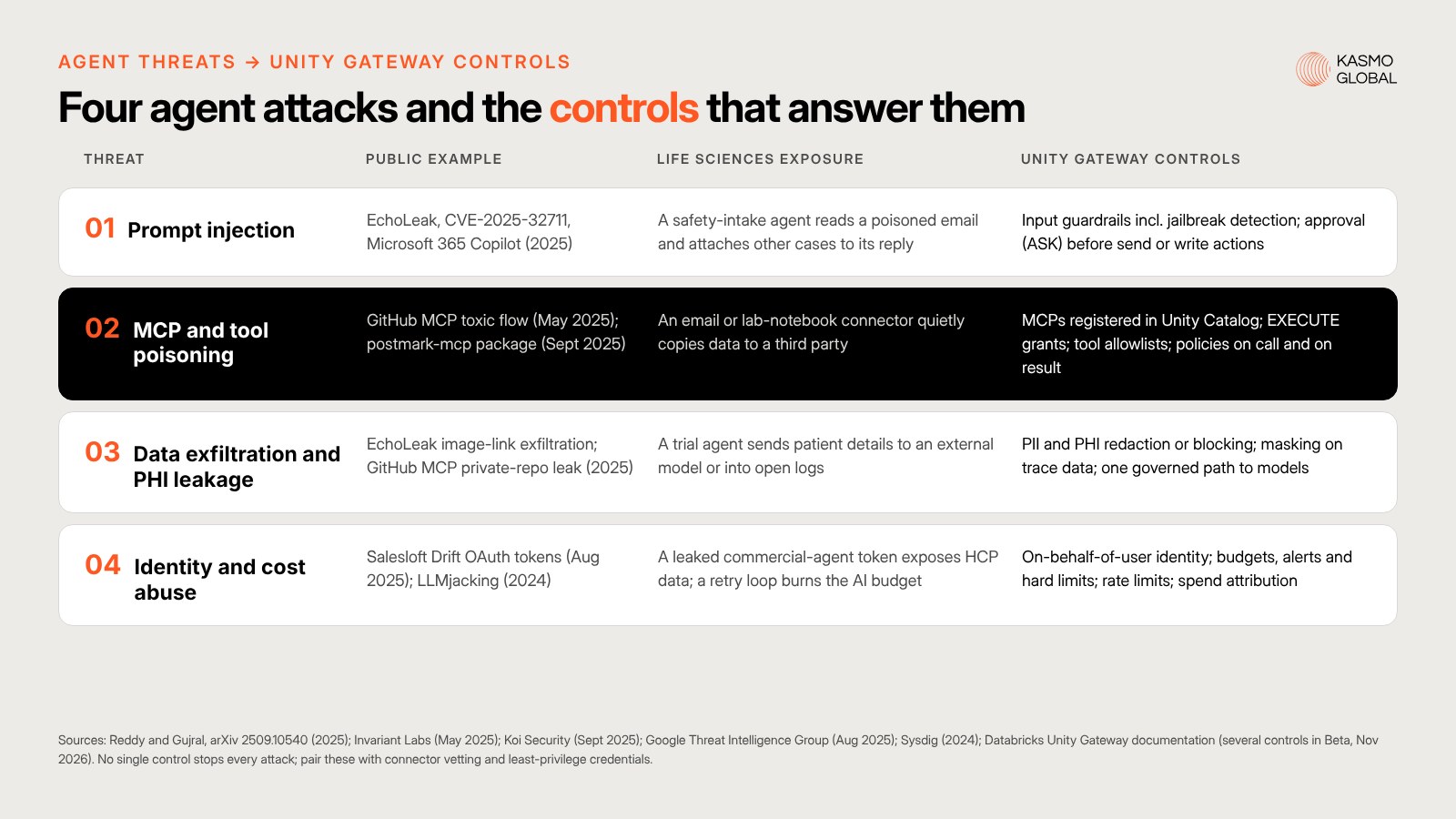
Four agent attack patterns have public, documented examples and map directly onto life sciences workflows: prompt injection, MCP and tool poisoning, data exfiltration and PHI leakage, and identity and cost abuse. Each one below pairs a real incident with the way it would play out inside a biopharma, biotech or medtech company.
1. Prompt injection: when content becomes instructions
Prompt injection is an attack in which instructions hidden in content an agent reads, such as an email, a PDF or a web page, override the instructions the agent was given. EchoLeak (CVE-2025-32711) showed this in production: researchers at Aim Labs found that a single crafted external email could lead Microsoft 365 Copilot, without any user interaction, to pull internal data and send it out through an auto-fetched image link. Microsoft fixed the flaw server-side in May 2025 and reported no evidence of exploitation in the wild.
Life sciences exposure. A pharmacovigilance intake agent that reads inbound safety emails, or an R&D literature agent that ingests third-party PDFs, reads untrusted content by design. One injected sentence in a case narrative could tell the agent to attach other cases or patient identifiers to its reply.
2. MCP and tool poisoning: when the connector is the attacker
MCP and tool poisoning is an attack in which a Model Context Protocol server or tool, or the data it returns, carries malicious behavior into an agent. In May 2025 Invariant Labs showed that a malicious issue in a public GitHub repository could hijack an agent using the GitHub MCP server and make it leak private repository data into a public pull request, a flaw in the agent architecture rather than the server code. In September 2025 Koi Security reported postmark-mcp, a copycat npm package whose version 1.0.16 blind-copied every email sent through it to an attacker's address.
Life sciences exposure. Medical affairs and clinical operations teams are connecting agents to email, document management, electronic lab notebook and CTMS systems through MCP. An unvetted connector can copy medical information responses, protocol drafts or site correspondence to a third party without any visible error.
3. Data exfiltration and PHI leakage: when the output is the breach
Data exfiltration through an agent happens when sensitive data leaves through the agent's own outputs, tool calls, model endpoints or logs rather than through a stolen database. EchoLeak hid data inside a generated link; the GitHub MCP case moved data through a legitimate tool call.
Life sciences exposure. A clinical trial agent that summarizes adverse events can send identifiable patient details to an external model endpoint, or write them into prompt and response logs that more people can read than the source data. For HIPAA-covered data, both are disclosures.
4. Identity abuse and denial of wallet: when the agent's keys are the target
Identity abuse is the theft or misuse of the tokens, keys and service identities that agents run under, and denial of wallet is the cost damage that follows when those credentials are used to run models at the victim's expense. Google Threat Intelligence Group reported that from August 8 to at least August 18, 2025, the actor UNC6395 used stolen OAuth tokens from the Salesloft Drift AI chat agent to query customers' Salesforce instances and hunt for credentials such as AWS keys and Snowflake tokens, with more than 700 organizations potentially affected. Earlier, Sysdig's 2024 LLMjacking research estimated that stolen cloud credentials used to run hosted models could cost a victim over $46,000 per day in a worst case.
Life sciences exposure. Commercial agents often hold long-lived, broadly scoped CRM and data warehouse tokens. A leaked token exposes HCP and account data; a runaway retry loop can burn a quarter's AI budget in days.
How does Unity Gateway counter each agent attack?
Unity Gateway counters agent attacks by putting every model request and MCP tool call behind one policy point that knows the calling user, the agent and the tool. No single control stops every attack, so the table pairs each threat with the Unity Gateway controls Databricks documents and the controls a life sciences team still needs around them.
| Threat | Public example | Unity Gateway controls | Also needed |
|---|---|---|---|
| Prompt injection (OWASP ASI01) | EchoLeak, CVE-2025-32711 (2025) | Input guardrails including jailbreak detection; service policies that require approval (ASK) before write or send actions; tool allowlists that limit what an injected instruction can reach | Treat retrieved content as untrusted; restrict outbound links and rendering in agent UIs |
| MCP and tool poisoning (ASI02, ASI04) | GitHub MCP toxic flow (May 2025); postmark-mcp (Sept 2025) | MCP servers registered in Unity Catalog with EXECUTE grants; per-MCP tool selection that hides and rejects unselected tools; ON CALL and ON RESULT policies; QPM rate limits | Approved-connector intake and code review; pin versions; block unregistered MCP servers |
| Data exfiltration and PHI leakage | EchoLeak; GitHub MCP case; shadow AI in 43% of incidents (IBM 2026) | PII and PHI guardrails that redact or block on input and output; Sensitive Data Detection policies on MCP calls; PII masking on trace data; one governed path to external models | Unity Catalog row filters and column masks on source data; business associate agreements with model providers |
| Identity abuse and denial of wallet (ASI03) | Salesloft Drift OAuth tokens (Aug 2025); LLMjacking (2024) | On-behalf-of-user identity so agents inherit user permissions; budgets, alerts, hard spend limits and rate limits by user, team, agent and model; spend attribution | Short-lived tokens; credential rotation; anomaly review of usage tables |
Two documented limits shape the design. Databricks' guardrails documentation states that each guardrail evaluates one message at a time and that tool-call payloads are not sent to the guardrail evaluator, so multi-turn manipulation and content inside tool arguments also need service policies and tool scoping. The same page lists jailbreak detection rather than a separate prompt injection category, so teams should test guardrails against their own injection cases.
How do Cost, Choice and Control apply to agent governance in life sciences?
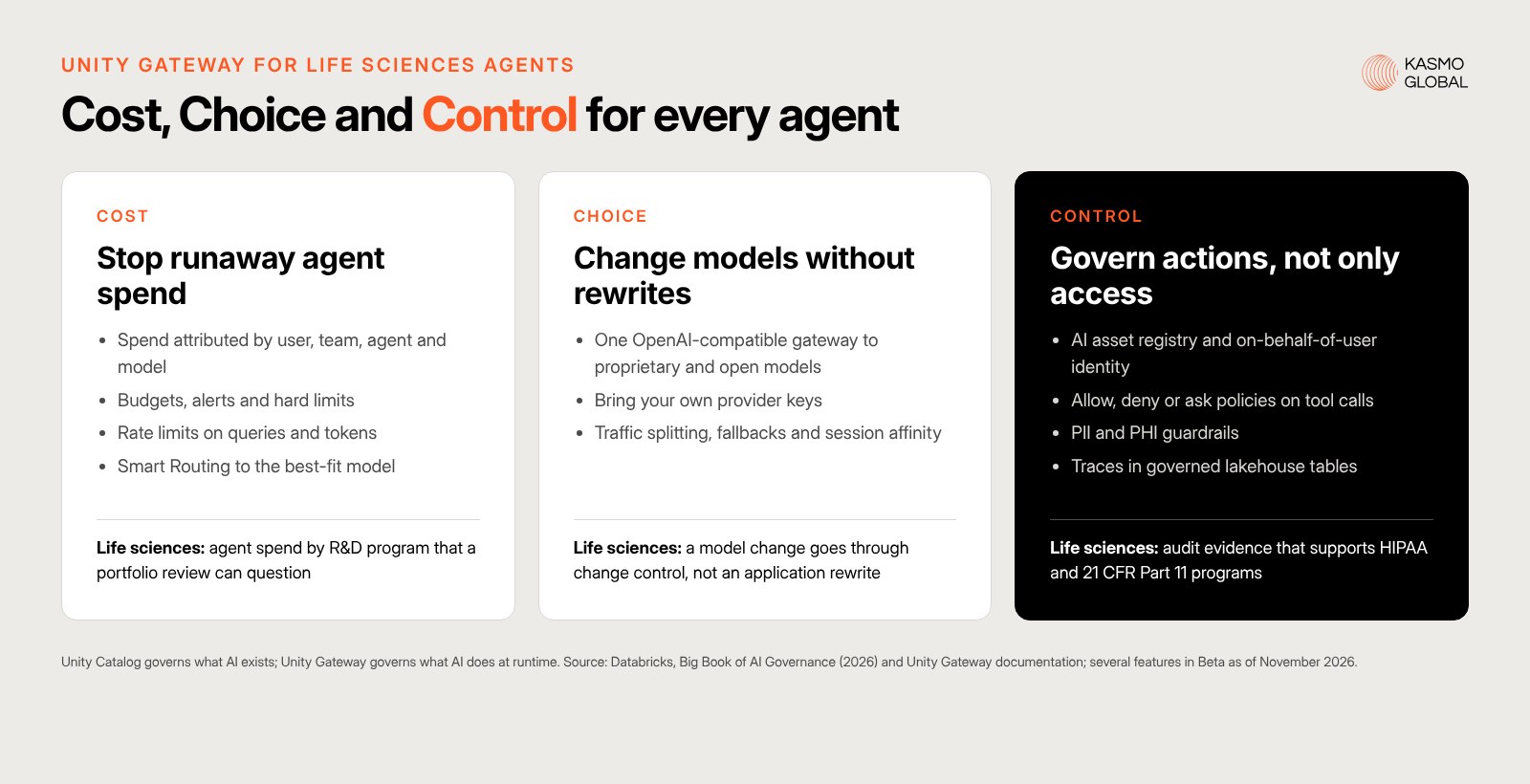
Databricks organizes Unity Gateway around three outcomes: Cost (understand, attribute and limit AI spend), Choice (use the right proprietary or open model for each task without lock-in) and Control (govern, guard and trace every AI interaction). In life sciences each one maps to a specific operating risk: runaway agent spend, model changes in validated processes, and regulated data in prompts.
Cost: stop runaway agent spend before it reaches finance
Cost governance for AI agents means every token is attributed to a user, team, agent and model, and limits apply before the bill arrives. Unity Gateway provides usage dashboards across providers, budgets per user and per team or application, alerts as usage nears a threshold, hard limits that block requests once a budget is exceeded, and rate limits in queries and tokens per minute. Databricks reports that its Smart Routing feature, which sends each task to the most cost-efficient model that meets quality requirements, can match frontier quality at up to 30% lower cost per task; that is a Databricks figure, not a Kasmo Global result. For R&D organizations, attribution by program turns agent spend into a line item a portfolio review can question.
Choice: change models under change control, not code rewrites
Model choice matters in life sciences because the best model for summarizing a protocol is rarely the best for writing statistical code, and the preferred model will change. Unity Gateway exposes leading proprietary and open models, plus customers' own provider keys, through one OpenAI-compatible interface, with traffic splitting, fallbacks when a model is unavailable, and session affinity for multi-turn conversations. For GxP-adjacent workflows this makes a model change a configuration change that can go through documented change control and side-by-side evaluation, instead of an application rewrite that reopens validation from scratch.
Control: govern actions, not only access
Control for AI agents means deciding each action in context and keeping the evidence. Unity Catalog serves as the AI asset registry, with EXECUTE grants, attribute-based access control and on-behalf-of-user identity that carries the end user's permissions through model calls, tool calls and data access. Unity Gateway adds service policies that allow, deny or ask for approval before a tool runs, guardrails for PII and PHI, unsafe content and jailbreak attempts, and tracing through MLflow Tracing and payload logging into governed lakehouse tables, with PII masking on the trace data itself. A clinical operations agent can then read the CTMS freely but must get human approval before it emails a site.
How do Unity Gateway controls map to HIPAA, GxP and FDA expectations?
Unity Gateway controls map to life sciences regulations as supporting evidence, not as compliance on their own: the platform supplies access control, audit trails and traceability, and the company still owns validation, policies, risk assessment and procedures. The table shows where the controls fit.
| Framework | What it expects | Supporting Unity Catalog and Unity Gateway controls | Still the company's job |
|---|---|---|---|
| HIPAA Security Rule (45 CFR 164.312) | Access control, audit controls, person or entity authentication for systems holding ePHI | EXECUTE grants and ABAC on agents and MCP servers; on-behalf-of-user identity; PHI redaction guardrails; audit and trace tables | Risk analysis, minimum-necessary policies, business associate agreements |
| 21 CFR Part 11 (11.10) | Limited system access and secure, computer-generated, time-stamped audit trails for electronic records | Centralized access policies; traces of prompts, responses, tool calls and policy decisions stored in governed tables | Computer system validation, record retention, electronic signature procedures |
| FDA draft guidance on AI for regulatory decision-making (January 2025) and FDA/EMA Guiding Principles of Good AI Practice (January 2026) | A risk-based credibility assessment of each AI model for its context of use, with lifecycle oversight | Model registry, traffic splitting and evaluations for controlled model changes; usage and quality telemetry over time | Defining context of use, credibility plans, documentation for submissions |
| NIST AI RMF 1.0 and Generative AI Profile (NIST AI 600-1) | Govern, map, measure and manage AI risk, including information security and data privacy risks of generative AI | Asset inventory, guardrails, policy enforcement and telemetry as measurable controls | Risk ownership, governance board, incident response |
The FDA's January 2025 guidance remained a draft at the time of writing, and the joint FDA and EMA principles are high-level rather than formal guidance, so teams should recheck both before submission work.
How does Kasmo Global approach AI agent governance on Databricks?
Kasmo Global approaches AI agent governance on the Databricks Data + AI Platform with governance first and agents second. Kasmo Global's view is that most agent incidents trace back to three gaps (agents no one registered, tools no one scoped, and credentials no one tied to a person), so those gaps close before any agent reaches regulated data. The pattern runs in six steps:
- Inventory. Register every model endpoint, agent, MCP server and tool in Unity Catalog, and route external AI through Unity Gateway so shadow AI becomes visible.
- Identity. Run agents on behalf of the user wherever possible, with short-lived credentials and no shared service accounts for regulated data.
- Tool scope. Expose only the tools each agent needs, and require approval for any write, send or delete action that touches GxP, patient or partner systems.
- Guardrails. Turn on PII and PHI redaction or blocking for clinical, safety and patient-facing agents, and test guardrails against the team's own injection cases.
- Budgets. Set budgets and rate limits by program, team and agent from day one, starting with visibility and tightening where the data shows waste.
- Evidence. Keep traces and policy decisions in governed tables, review them on a schedule, and feed findings into validation and incident response.
Unity Catalog. Databricks Unity Catalog is the unified governance layer for data and AI assets on Databricks, covering access control, discovery, business semantics, lineage, quality monitoring and open sharing across tables, files, models, agents, skills and MCP tools. Learn more: Unity Catalog product page
Unity Gateway. Unity Gateway is the enterprise AI control plane for accessing, managing and optimizing AI across every team, application, model and agent. It provides reliable capacity across leading proprietary and open models through a single gateway, Smart Routing that directs each request to the best-fit model for cost, quality and performance, and budgets, rate limits and spend attribution by user, team, agent and model. Access policies, guardrails and audit trails span models, agents, MCPs and tools. Learn more: Unity Gateway product page · Unity Gateway documentation
Agent Bricks. Agent Bricks is an open agent developer platform for building, deploying and optimizing custom agents on any model, framework or harness, with all your data. It is powered by Omnigent, a multi-harness agent development platform, and includes AI search, memory, sandboxing, evaluations, observability and monitoring. Learn more: Agent Bricks product page
The same governance pattern applies to patient-facing work. For how human review and consent controls fit patient-support agents, see What Capabilities Matter Most for Biopharma Patient Engagement and Adherence in 2026?
Want to know where your AI agents are exposed today? Book an AI assessment with Kasmo Global, or explore how we support pharmaceutical companies.
Frequently asked questions
What is AI agent governance?
AI agent governance is the set of identity, permission, policy, guardrail, cost and tracing controls that decide what an AI agent may access and do at runtime, and that record what it did. It extends data governance from who can read data to which actions an agent may take for which user.
What is Unity Gateway in Databricks?
Unity Gateway is the Databricks AI control plane that extends Unity Catalog governance to every AI interaction at runtime. It provides one governed gateway to proprietary and open models, budgets and spend attribution, access policies, guardrails and audit trails across models, agents, MCP servers and tools.
Can Unity Gateway stop prompt injection?
Unity Gateway reduces prompt injection risk but no single control stops it. Input guardrails, including jailbreak detection, catch some attempts; tool allowlists and service policies that require approval before write or send actions limit what an injected instruction can do. Databricks documents that guardrails check one message at a time and do not inspect tool-call payloads, so layered controls are needed.
How does Unity Gateway govern MCP servers?
Unity Gateway governs MCP servers by registering them in Unity Catalog, requiring EXECUTE permission to call them, exposing only selected tools, evaluating service policies before a tool runs and on its results, applying rate limits, and recording tool requests, responses and policy decisions in a unified trace table.
Does Unity Gateway make an AI system HIPAA or Part 11 compliant?
No platform makes a system compliant on its own. Unity Gateway and Unity Catalog supply controls that support HIPAA and 21 CFR Part 11, such as access control, PHI redaction and time-stamped traces, while the company remains responsible for risk analysis, validation, procedures and agreements with providers.
How do AI agents increase cloud and AI costs?
AI agents increase costs because one agent session can involve dozens of model calls, tool calls and retries, and stolen credentials can run models at the victim's expense. Budgets, alerts, hard limits, rate limits and spend attribution by user, team, agent and model keep that spend visible and bounded.
Are Unity Gateway features generally available?
Not all of them. At the time of writing, Databricks documentation listed Unity Gateway guardrails, service policies on MCP servers and cost controls as Beta features that an administrator enables from the Previews page. Teams should check current documentation before planning production use.
How does Kasmo Global help life sciences companies govern AI agents?
Kasmo Global, a life sciences data and AI consulting company and Databricks partner, helps biopharma, biotech and medtech teams inventory their AI estate, scope agent identities and tools, set PHI guardrails and budgets, and keep audit evidence in governed tables using Unity Catalog and Unity Gateway on the Databricks Data + AI Platform.
Sources
Put this into practice with our team
Share what you are working on and we will show how governed data and AI can move your programs forward.
Email marketing@kasmoglobal.com